
My last essay was about Beginnings. This one is about Endings.
Many years ago, I was walking briskly through the Safeway parking lot in Saratoga when I noticed an elderly man slowly making his way towards the store. Bent over his shopping cart — which, I thought, made a surprisingly good walker — he shuffled along as I approached. As we passed, I caught his eye and, as is my habit with strangers, I offered a breezy “Hi” before continuing on my way.
A few moments later, I heard someone calling behind me: “Excuse me! Excuse me!”
I turned to see the gentleman hurrying after me as quickly as he could. I stopped, assuming that I had dropped something, which I do with embarrassing frequency. When he finally reached me, he paused to catch his breath, took in my questioning gaze, and said: “I just wanted to thank you, young lady, for noticing me.”
I have rarely been so moved by so few words
That brief encounter captured something about growing old ― particularly in affluent, urban societies, and especially where nuclear families predominate. As people age, they often become increasingly invisible: not exactly shunned, but acknowledged rather than included, noticed rather than engaged, tolerated more than needed.
The encounter also made me think about something economists ― in their rather dismal way ― measure. They call it the “dependency ratio” or, more evocatively, the “demographic burden”.
The World Bank’s total dependency ratio adds the number of people under 15 to the number of those aged 65 and over, and expresses the total as a percentage of the population aged 15–64. The old-age dependency ratio, on which I will focus, compares only those aged 65 and over with the working-age population.
What is the point of having a large working-age population if its members cannot find work?
The measure helps governments plan for pensions, healthcare, taxation, and retirement. But its terminology also reveals something about how we think about old age. The ratio is, after all, purely demographic. It does not tell us who is working or dependent: many people between 15 and 64 do not work, while many over 65 do. Nevertheless, the very word dependency subtly transforms an age group into a burden.
Economic development has a parallel road — demographers call it “demographic transition.” Poor countries tend to begin with many children and relatively few elderly people. As mortality falls and education improves — particularly for women — families have fewer children. For a few decades, the working-age population becomes unusually large, creating the possibility of a “demographic dividend”. Eventually, however, fertility falls below replacement level, people live longer, and the dividend gives way to population ageing.
Today’s global picture is interesting.
The wealthy countries of Western Europe and East Asia carry some of the world’s heaviest old-age dependency burdens. By 2060, Japan will likely be approaching three older people for every four working-age adults, while South Korea is ageing even more rapidly. Japan, South Korea, Italy, and Germany all face rising pension and healthcare expenditures alongside shrinking workforces.
The United States, Canada, Australia, and Ireland have more moderate ratios than many other wealthy countries. It was interesting for me, as an economist and an immigrant, to observe that sustained immigration has helped the United States maintain a younger age structure. Immigrants arrive disproportionately during their working and family-forming years, contributing directly to the workforce but also increasing the country’s birth-rates. Their fertility, however, tends to decline over time and converge towards national norms. American fertility has now been below replacement level for years; absent continued immigration, the country’s demographic profile will tend towards a declining population size and an age-structure resembling that of other ageing advanced economies.
Upper-middle-income countries such as China and Thailand face a different danger. Their populations are ageing rapidly after decades of falling fertility, raising the possibility that they may “grow old before they grow rich.”
Low-income countries generally have the lightest old-age dependency burdens but the heaviest youth dependency. India, for example, still has roughly 10 people aged 65 or over for every 100 people aged 15–64. This is not because India has few older people, but because it has an exceptionally large working-age population — the legacy of decades of relatively high fertility. Ironically, what was once considered the limited success of India’s family-planning campaign — Do yā teen bachche bas — now looks rather different. But what is the point of having a large working-age population if its members cannot find work? A large young labor force becomes a demographic dividend only when sufficient productive jobs exist. Chief Justice Surya Kant’s characterization of unemployed young activists as “cockroaches” became a flashpoint for the frustrations of India’s Gen Z. Abhijeet Dipke and the Cockroach Janta Party (that he satirically named) has quickly grown into a powerful youth protest movement.
These demographic trends are usually presented as economic challenges. But they raise a deeper question: What does a society owe those whose principal earning years are behind them? More fundamentally, how can we ensure that old age is not treated merely as a period of dependency, but as one of continuing dignity, connection, and contribution?
I live with my father, who is 102, and my husband, who is 91, so I think about these questions regularly. Although both were “old souls” even when they were young, I am repeatedly amazed by the wisdom they possess at this stage of their lives ― wisdom being that curious, ephemeral, almost indefinable combination of perspective, judgment, detachment, compassion, equanimity, and love.
Across cultures and centuries, wise men have generally been depicted as old and white-bearded: sages, saptarishis, rabbis, lamas, sophoí, elders, pīrs, and druids. Women, too, have their archetypes of wisdom: the matriarch, the grandmother, Gaia herself — serene, powerful, generous, elemental. True, the archetypical wisdom of King Solomon seems to have been first exhibited by him at a very young age — when he devised the famous test for determining which of two women was the mother of a baby. Perhaps that is why his wisdom was interpreted as a divine gift, not something acquired through experience.
Mathematical and scientific brilliance, in contrast, is frequently associated with youth. Newton laid the foundations of calculus and his theory of gravitation in his early twenties. Einstein published his extraordinary 1905 papers on special relativity and mass–energy equivalence — commonly expressed as E=mc2 — at the age of 26. Marie Curie was 30 when she discovered polonium and radium. Ramanujan published his first paper on the properties of Bernoulli numbers at 23. Galileo, whose great telescopic discoveries came in his 40s, offers some reassurance to the not-so-young-anymore. Yet wisdom is not the word we ordinarily use to describe these brilliant achievements — that seems to require experience and the opportunity to reflect… which is why it does not generally arrive early.
The four āśramas, or stages of life, described in the Hindu philosophical tradition, offer a strikingly different perspective on ageing. Brahmacharya is the stage of the student, devoted to learning, discipline, and the formation of character. Grihastha is the stage of the householder, who marries, raises a family, earns a livelihood, and assumes responsibility for supporting dependents and society. Vānaprastha marks a gradual withdrawal from those responsibilities: authority is increasingly delegated or handed to the next generation, while one’s role shifts towards that of counsellor, teacher, mentor, guide. Finally comes Sannyāsa, the stage of renunciation, in which worldly ambition and attachment give way to contemplation, compassion, and the pursuit of moksha — spiritual liberation.
In the Hindu philosophical tradition, elderly are valued not despite their advancing years, but because of what those years are expected to have cultivated in them
What is remarkable is that the last two stages, corresponding broadly to what modern economists would classify as the elderly years, are not conceived as periods of redundancy. Each is assigned a distinct and valued social function. In Vānaprastha, elders remain engaged, offering judgment, experience, and continuity while gradually relinquishing authority. In Sannyāsa, they become repositories of spiritual insight, no longer defined by occupation or status but by wisdom, equanimity, and compassion. The elderly are valued not despite their advancing years, but because of what those years are expected to have cultivated in them.
Modern economics measures what older people consume. The āśrama tradition asks what, in their changing social roles, they contribute. Perhaps the greatest failure of our national accounts is not simply that they underestimate the contributions of the elderly. It is that we conflate economic dependence with lack of value.
To be fair, modern economics has begun to correct one important omission. Conventional measures of national income exclude unpaid household services, most of which are still provided by women. A growing number of countries now use time-use surveys and ‘household satellite accounts’ to estimate their value.
The figures are remarkable, although differing definitions and valuation methods make international comparisons difficult. Unpaid household services have recently been valued at more than 60 per cent of GDP(!) in the United Kingdom and somewhere between 25 and 37 per cent in Canada. American estimates, too, demonstrate that unpaid household production would add enormously to measured output, although it remains outside official GDP.
The unselfish love behind countless acts of devotion — the quiet generosity with which grandparents give their time, patience, and affection — cannot be entered into any national account
I suppose, then, that the contributions of grandparents are also partially recognized in these satellite accounts and time-use surveys. I am glad that, in some small way, the numbers would acknowledge Bāuji, my paternal grandfather, who endured the blistering Delhi summer, travelling by crowded DTU buses without air conditioning from his home to ours just to teach me ‘Beginning Algebra’. I had changed schools midway through the academic year, and my new school had introduced the subject a year earlier than my previous one. The numbers might also acknowledge Mātāji, my maternal grandmother, who must have spent hundreds of hours massaging my scalp with bādām rogan (sweet almond oil) as we sat under the gentle winter sun — she on a chārpoy, I on the ground, leaning contentedly against her elegant cream-colored soft silk sari. Today, I pay $150 an hour for a massage. Hers, of course, was priceless.
But such statistics tell only part of the story. The unselfish love behind countless acts of devotion — the quiet generosity with which grandparents give their time, patience, and affection — cannot be entered into any national account. Yet it is precisely this love that gives children the emotional security, confidence, and resilience they need to flourish and, eventually, to become the productive adults whose earnings are so carefully recorded in GDP.
When I left for graduate school in the United States, Mātāji and Bāuji wrote to me regularly on Aerogrammes, the international cousins of the now-iconic blue trifold Inland Letters that is a staple of 20th century Indian nostalgia. Mātāji’s letters, written in beautiful, chaste Hindi, invariably began with extravagant affection. Her opening salutation alone often filled the first page: “My dear daughter, my child brighter than the full moon, surely destined to bring glory to our family and our clan…” Headmaster Bāuji, who had taught mathematics and English at a high school near Lahore, wrote in formal English in an elegant, flowing cursive hand. He would devote all three pages to telling me how much he missed me.
My two other grandparents made sure I had a steady supply of my favorite homemade pinnis and Karachi halva — sweetmeats sturdy enough to survive the long journey to California and thus entrusted to friends or acquaintances who happened to be travelling here. Yes, my lifelong weakness for sugar has a history!
I hope that the busy graduate student — absorbed in the exhilaration of a new country, inspired by brilliant professors on a breathtaking campus, discovering love, and beginning the career whose future earnings would one day be faithfully recorded in GDP — found the time to write back. Sadly, I cannot remember whether I did. If I did not, neither Mātāji nor Bāuji ever let me know. Whenever I returned home, they welcomed me with boundless love and not a hint of reproach.
Burden? Really?
If people can expect healthy, active lives into their eighties and beyond, why should they not acquire new skills, begin new careers, or contribute in entirely different ways?
One final thought. Modern medicine, clean water and sanitation, better nutrition, public health, and education are helping people live longer and healthier lives. More than ever before, people are trying to counter the effects of ageing and remain active in retirement. Fair enough. But as life expectancy continues to rise, perhaps retirement itself deserves rethinking. If education belongs to youth, why should retraining not belong to old age? If people can expect healthy, active lives into their eighties and beyond, why should they not acquire new skills, begin new careers, or contribute in entirely different ways?
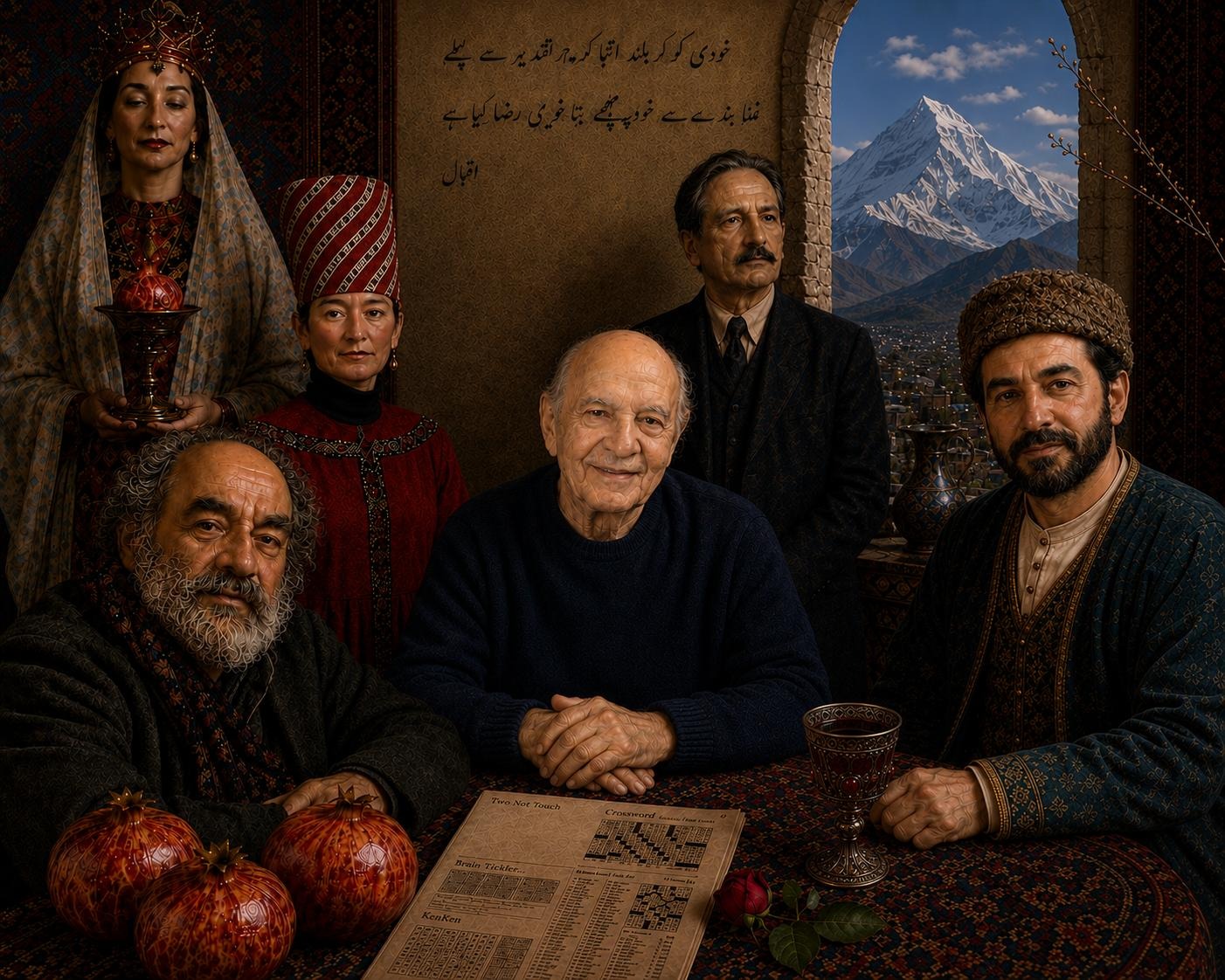
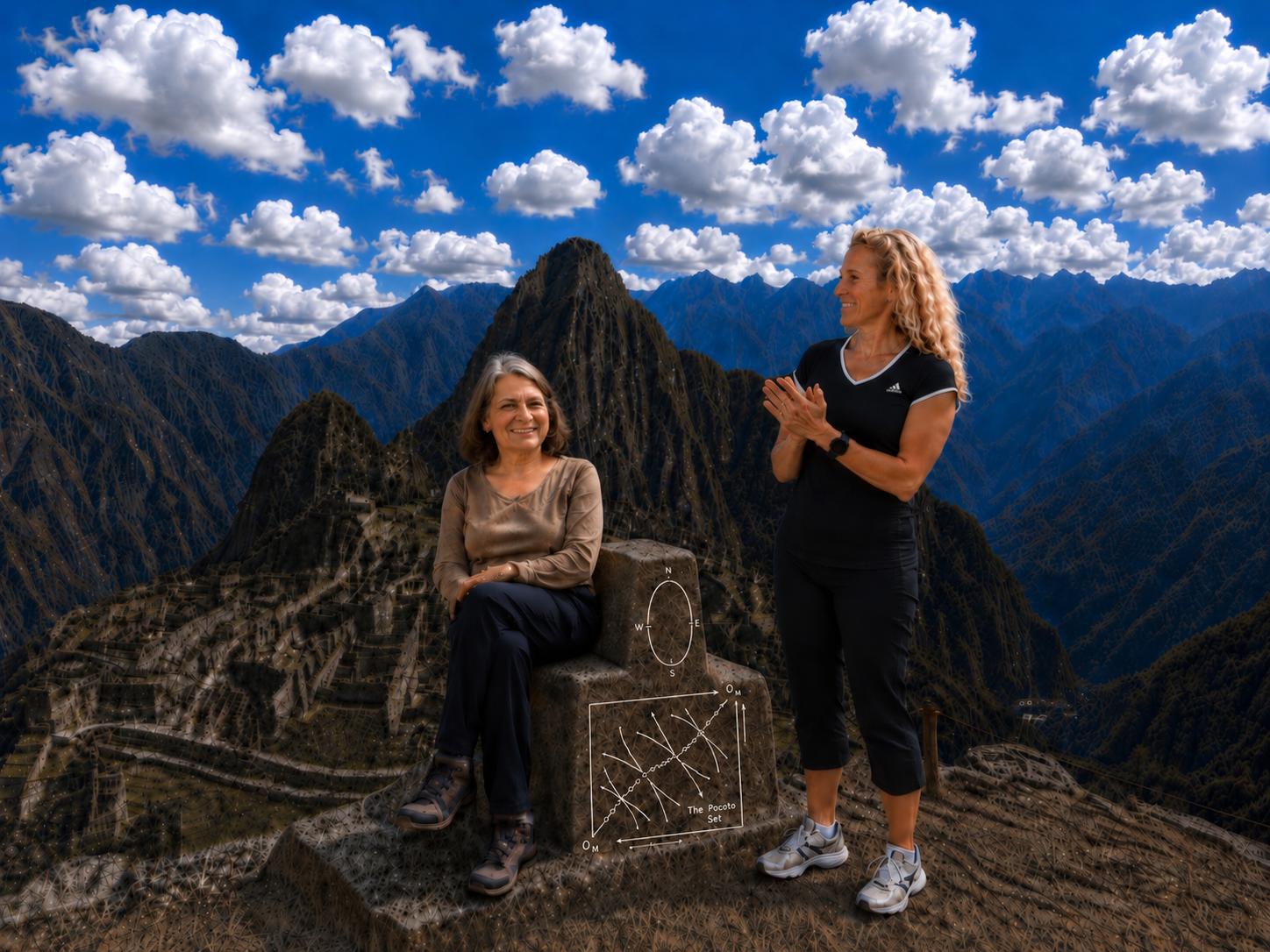
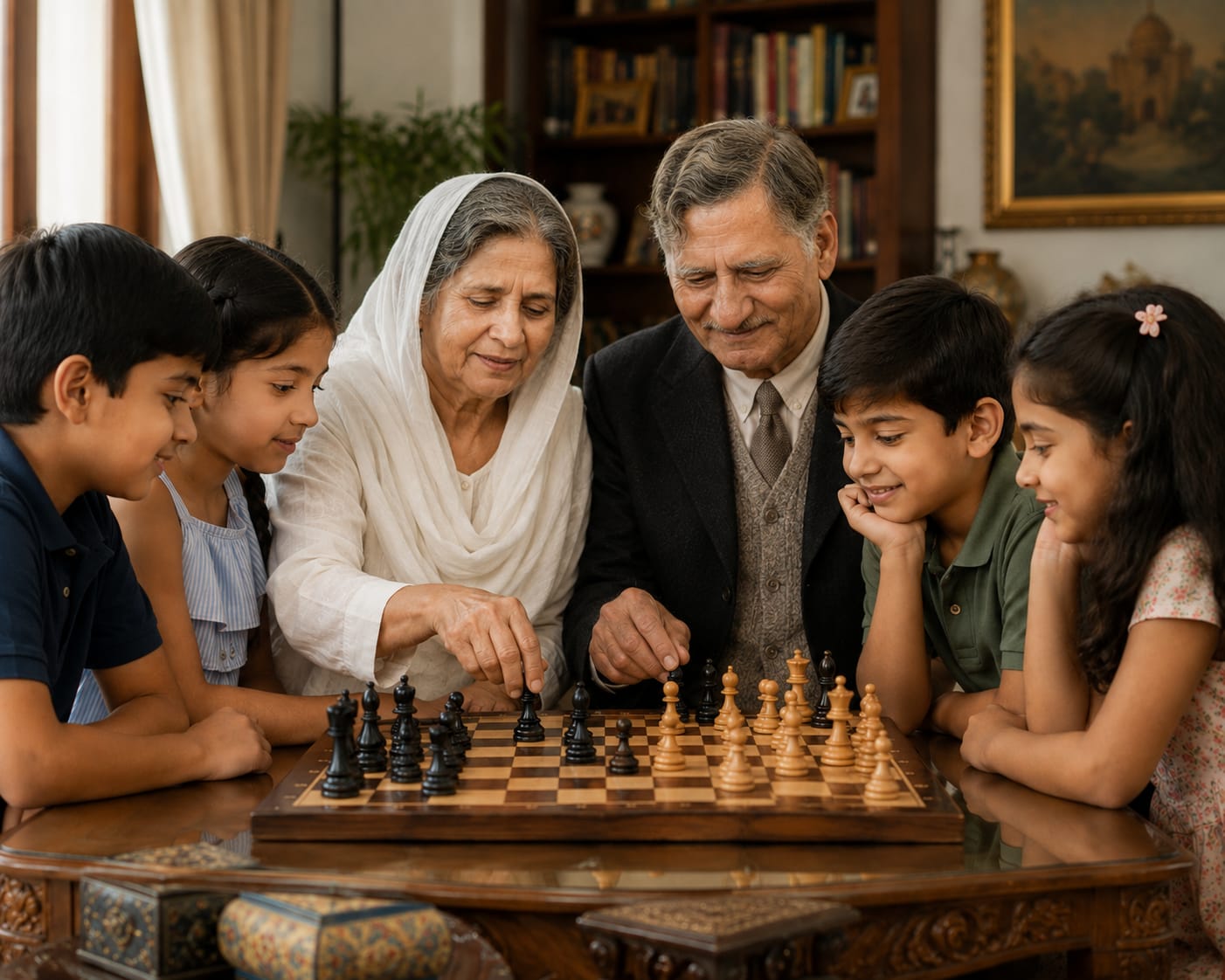
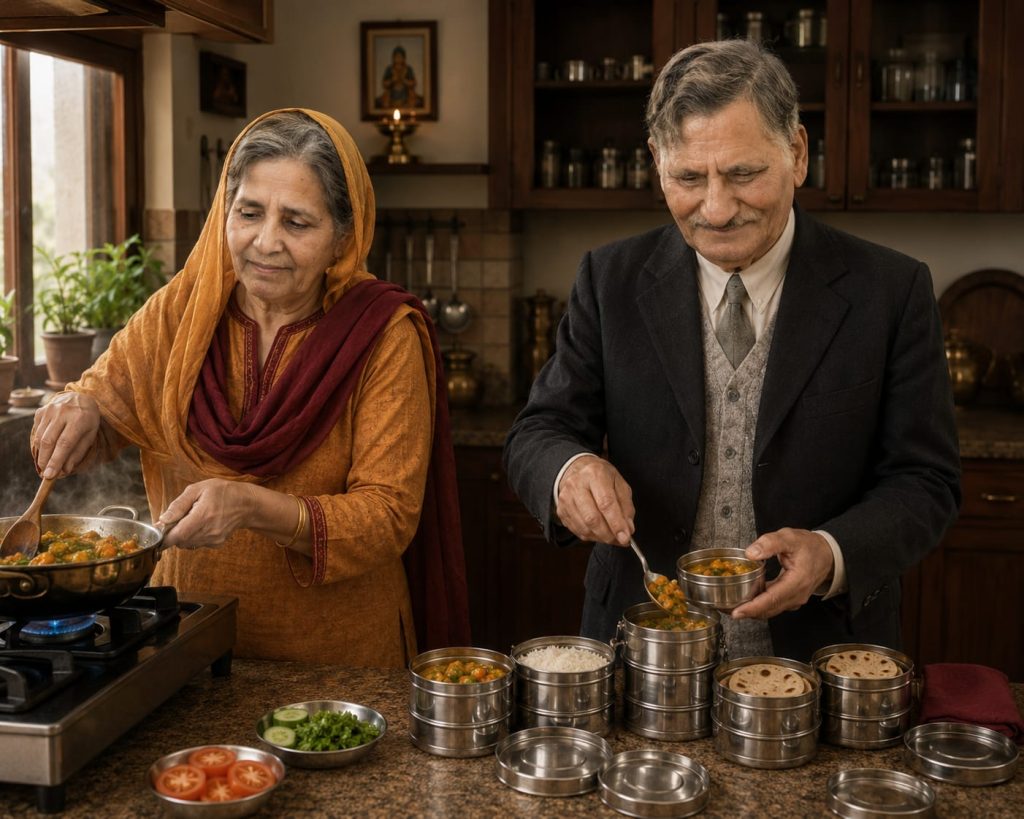
I recently saw the lovely musical adaptation of Ritesh Batra’s film The Lunchbox at Berkeley Repertory Theatre. Through an improbable error in Mumbai’s famously efficient dabbāwāllā system, a lonely wife and a solitary, irritable widower approaching retirement become correspondents and, eventually, fall in love. In the musical’s ending, they leave Mumbai for Bhutan with her daughter. I loved the happy ending… but I wondered about their life in a new country and how they intended to support themselves. The accompanying pictures offer my imagined answer: a new business venture in Bhutan and precious time with grandchildren.
An ending, sure. But also a beginning:
Grow old along with me!
The best is yet to be,
The last of life, for which the first was made: — Robert Browning, Rabbi Ben Ezra
Are You Passionate About India's Future? Join Our Community to Collaborate, Advocate, and Create Positive Change.