
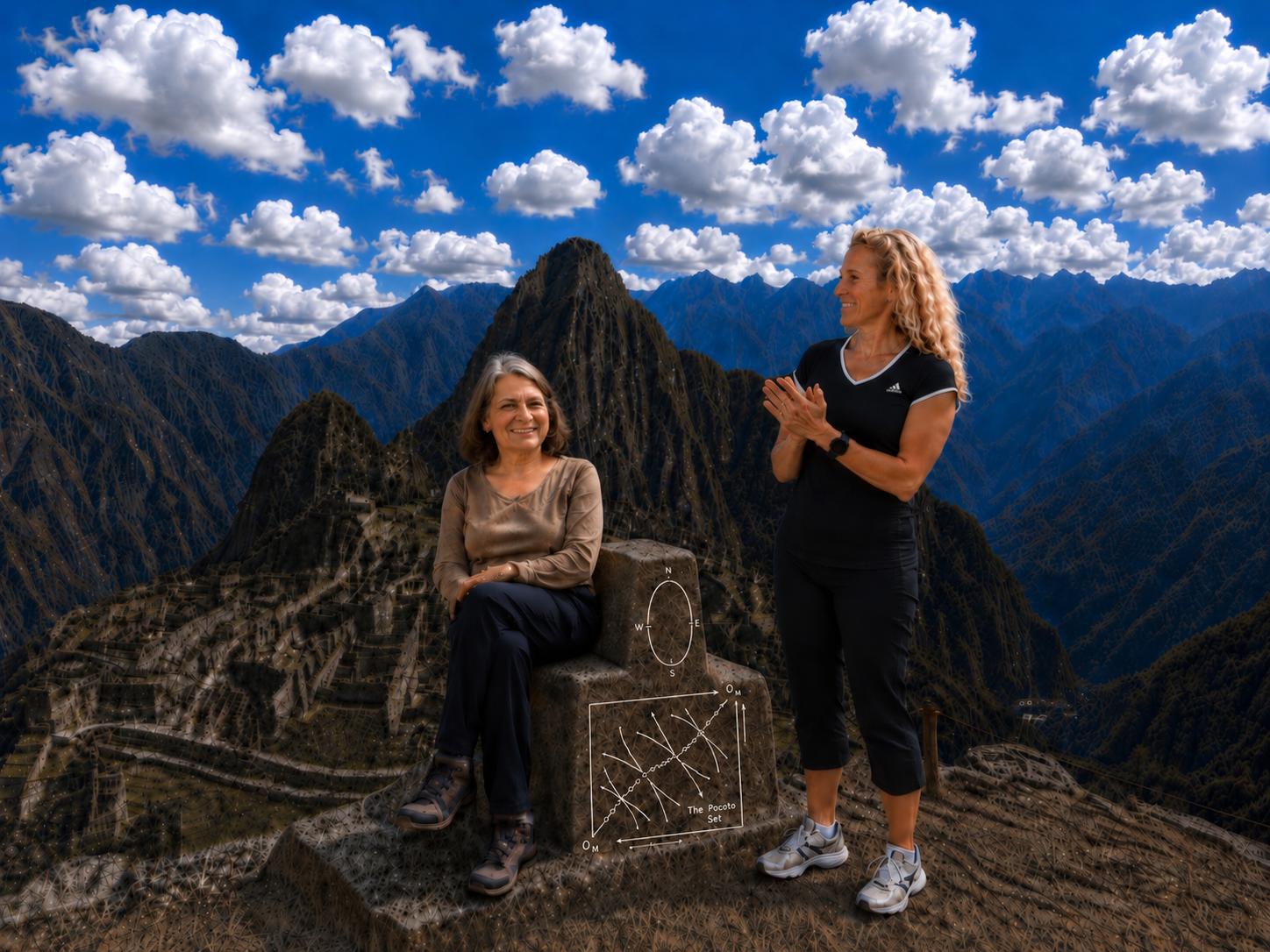

My week usually begins with a training session with Elisabetta, and it has been so for five years. As always, I was dreading it – not so much the workout itself but the debrief and confessional about the previous week: too much sugar and not enough exercise.
My fitness journey began soon after I arrived in the US as a grad student. My first trek – up to Vernal Fall in Yosemite – was with a friend (later my husband). For parts of the climb, Sidhartha had me holding on to his belt as he practically hoisted me up. All the while, he encouraged me with a not-very-helpful mantra: “It’s easy, Anu. You just have to put one foot in front of the other.”
From then on, my irrepressibly adventuring husband pulled me along on many treks: the Inca Trail to the magical site of Machu Picchu and its Intihuatana, the Hitching Post of the Sun; a month of high-altitude Gem2Gem camping, beginning with a parikrama of the impossibly blue Lake Mansarovar, continuing along the Friendship Highway – which, with its ruts and boulders and running streams, was anything but friendly – and ending at the dazzling Potala Palace in Lhasa; the Taurus Mountains of Turkey; Alaska and its mirror-image Patagonia. During the 25 years of our marriage, there were regular such adventures… and I became quite fit!
The sudden death of Sid, my tow truck and soulmate, was a shattering loss, one that I “some-or-the-how” (channeling a favorite uncle, whom we couldn’t bear to correct… and the phrase has become a mischievous family joke) survived. But the routines of my life changed dramatically, and I became especially reluctant to do the things we had enjoyed together. Yes… that too, but also the hiking, biking, gaming, traveling. Every year added a pound and took a million steps off my pedometer.
Justice requires us to care about where each person’s foot was first placed
Fast forward 20 years. By then, my ‘kids’ and their kids were immersed in their own active family lives, and I was reluctant to accompany them on holidays for fear of holding them back.
So… I found Elisabetta!
At our orientation session, Elisabetta asked why I wanted to get fit, and I didn’t have to think for long: I wanted to be fit enough to accompany my children on some of their adventures.
We began our training sessions and made decent progress with the moving, lifting, squatting, stretching, and balancing. But the weight loss needed to support my workouts remained elusive, mainly because of what I came to recognize as my addiction to sugar. 15-20 pounds was not a daunting amount of weight to lose but I simply could not do it.
Over more than 200 sessions, Elisabetta tried every motivational trick and strategy she had in her jadu-ki-potli. She taped two notes to my freezer:
– Sugar = Inflammation, Weight and Puffiness, Lethargy, Poison, Dementia.
– Anu, stop! Turn around! Make tea instead!
Consistently, her advice was: “Anu, keep your eye on the goal and break it up into manageable, achievable, sub-goals.”
I’d banter back, “But if I don’t know where I’m going to, I’ll never be lost!”
On the weight-loss front: No dice. No joy. Goat droppings.
Over a year ago, my doctor suggested that I explore GLP-1 drug options, and I started reading up about them. During several exploratory conversations, Elisabetta urged caution, particularly for someone my age – she had not yet seen enough long-term evidence. She also argued that I, as someone who had survived two eight-hour Stanford qualifying exams in Micro and Macro, surely possessed enough discipline to lose 15 pounds without medication. To motivate me, my daughter added: “Mom, just deal! It’s willpower.” All said they would support me in whichever direction I decided to go.
I did regularly walk around our bug-shaped street – an oval with other streets leading off it. One afternoon, I was hailed by an old woman in an old, pre-GPS car being driven by her niece, who had forgotten her cellphone at home. They were lost and asked whether I could direct them downtown. Confidently and helpfully (I thought), I said: “Just drive on this street to the next intersection, turn left there; if you stay on that street, you’ll reach downtown in a half-mile.” Lovely old lady – LOL– thanked me profusely, and they drove off happily. I continued on my walk (Elisabetta might have said “saunter”) but, at the next intersecting street, I stopped in horror. That street was not going to take my LOL downtown; in fact, the route I had advised her to follow would lead to a dead-end. I was sick with worry for my LOL and somewhat discombobulated myself. I stopped to get my bearings – literally. Very soon, I was able to suss it out.
Imagine our oval street oriented along the North-South axis on a map and let us simplify to assume there are 4 streets leading off it at N, E, S, W as one walks clockwise (I learnt only this morning that Never Eat Soggy Waffles is a mnemonic for remembering the order…. it is also generally good advice 😊). I had started clockwise around the oval from my home at N and had reached only the NE quadrant when my LOL had flagged me down. But I thought I was further along on my walk– at the SE quadrant of the street! Oof! The street I had directed her to take was at right angles to the one I had intended.
My starting point had been off.
The goal is not perfection, but progress: reducing avoidable inequities in health, education, opportunity, and income, one step at a time
Economists have a phrase for this: Initial Conditions. In almost every theoretical model, where you begin matters. Change the starting point ever so slightly and the path – and often the destination – changes. The meteorologist Edward Lorenz stumbled upon this phenomenon while repeating a computer simulation of weather patterns. A tiny rounding difference in the initial numbers eventually produced an entirely different forecast. He later captured the idea in the question that gave the Butterfly Effect its name: Does the flap of a butterfly’s wings in Brazil set off a tornado in Texas?
My own sub-field is microeconomics. Its two fundamental theorems provide the intellectual foundation for the idea that competitive markets can work remarkably well. Here, “work well” means that they produce a particular kind of efficiency – Pareto efficiency – in which no one can be made better off without making someone else worse off.
It is a beautiful idea.
Of course, those elegant results depend on assumptions that real economies rarely satisfy. Within this framework, the justification for a government is that, to achieve efficiency, interventions are needed to regulate monopolies, tax pollution, provide better information, and supply public goods such as national defense, clean air, parks, and disease surveillance.
Competitive markets and governments acting in concert can be remarkably effective at allocating resources efficiently. But they do not decide who begins the race with education, wealth, health, confidence, or connections. Those are inherited. The market is not necessarily responsible for creating inequality – but neither does it possess inbuilt mechanisms to erase it.
A useful result in economics is that efficiency and equity are, in principle, separable. Markets can efficiently allocate resources once society has decided how resources should be distributed initially. In other words, economics itself leaves room – indeed, creates room – for society to decide what constitutes a fair starting point.
Whether inequality matters is ultimately not just an economic question but also a moral and political one. Economics tells us that initial conditions matter. In his influential work The Social Contract, the philosopher Jean-Jacques Rousseau asks what we owe one another. He argues that citizenship rests on a social contract: we accept obligations to one another in return for the benefits of living together. If so, efficiency alone cannot be enough – we cannot remain indifferent to inequalities that are accidents of birth. A child does not choose her parents, her genes, her neighborhood, or her country’s institutions. Yet these ‘initial conditions’ profoundly shape the opportunities available to her throughout life.
A child does not choose her parents, her genes, her neighborhood, or her country’s institutions
A just society need not guarantee equal outcomes. Talent, effort, risk-taking and creativity deserve to be rewarded. But neither should it treat accidents of birth as though they were achievements. Sid was right: life rewards those who keep putting one foot in front of the other. But justice requires us to care about where each person’s foot was first placed.
Amartya Sen makes all this practical – and therefore especially useful – for policymakers. He tells us that the objective of public policy need not be the discovery of a perfectly just distribution of income – a task on which reasonable people will forever disagree. Rather, it is to recognize the society we have inherited, identify the manifest injustices embedded in its initial conditions, and move – incrementally but deliberately – toward greater equity. Starting from the unequal world we inhabit, which reforms would move us toward greater justice? The goal is not perfection, but progress: reducing avoidable inequities in health, education, opportunity, and income, one step at a time.
The evidence on income and wealth distributions is sobering, especially in the market-friendly economies of the US and India, both of which have experienced impressive growth in national income.
But, in the US, Reagan-era deregulation of the 1980s initiated a dramatic increase in income and wealth inequality, a trend that has accelerated in more recent years. The storied land of the middle class is now better described as a country moving relentlessly towards a bimodal distribution – the rich and the poor.
In India, the richest 1% now receive about 22% of national income – among the highest shares in the world – and they own roughly 40% of the country’s wealth. India has gone from one billionaire in 1991 to more than 220 today, only third after the US and China, and it is now projected to outpace US and China in year-over-year billionaire generation. Wow! Meanwhile, according to the OECD, a child born into the poorest tenth of Indian households would need roughly seven generations to reach the average income (that really sucks!) and even in the US, “the land of opportunity”, it would take five. The star performer is Denmark, where it would take only two – a poor woman could hope to see her grandchild prosper. Initial disadvantages of birth not only account for a large part of the income distribution at any point in time but disadvantages persist over generations, more so in more unequal societies.
A very witty and equally successful friend of mine once answered a reporter who asked for the secret of his success: “I chose my parents well.”
It is perhaps no surprise that movements such as India’s Cockroach Janta Party have emerged to channel the frustrations of unemployed young people. Youth unemployment is now around 15% and the numbers are worse for urban youth, women, and the educated (40%!).
Beginnings matter – they constrain possibilities, shape journeys, and determine destinations
My mistaken directions to my LOL arose from a trivial error about where I thought I was standing, and the consequences were immediate. Beginnings matter – they constrain possibilities, shape journeys, and determine destinations.
Elisabetta must’ve had a sixth sense that I was thinking about these issues as I walked – not ran 😊 – circles around our home. At one of our recent sessions, she surprised me: she had changed her mind. She was now more comfortable with the available data. She had also been persuaded by the neurobiologist Stephan Guyenet’s reasoning in The Hungry Brain: some people are biologically predisposed to find weight-loss particularly difficult. And then there are doting, well-meaning uncles who regularly bring gifts of “imported” KitKats for 6-month-old infants! Knowing my history and details of my childhood, she now accepts that it may be much harder for me to lose weight on my own. Initial Conditions, yet again!
Soon after, I called Dr A to discuss the NexGen (already!) Zepbound.
With apologies to my LOL and with hope, “Machu Picchu, here I come! This time with my grandchildren.”
Endnote: “In my end is my beginning” – TS Eliot, Four Quartets
Are You Passionate About India's Future? Join Our Community to Collaborate, Advocate, and Create Positive Change.