
It was a lazy Sunday afternoon of Memorial Day weekend, and I was horizontal on the sofa… thinking about the people in my life who were gone, but still with me, within me. Also idly wondering if it was a good time to implement Steve Jobs’ 2-hour rule of regularly slotting in time for uninterrupted solitary thinking. I hadn’t yet put away my devices.
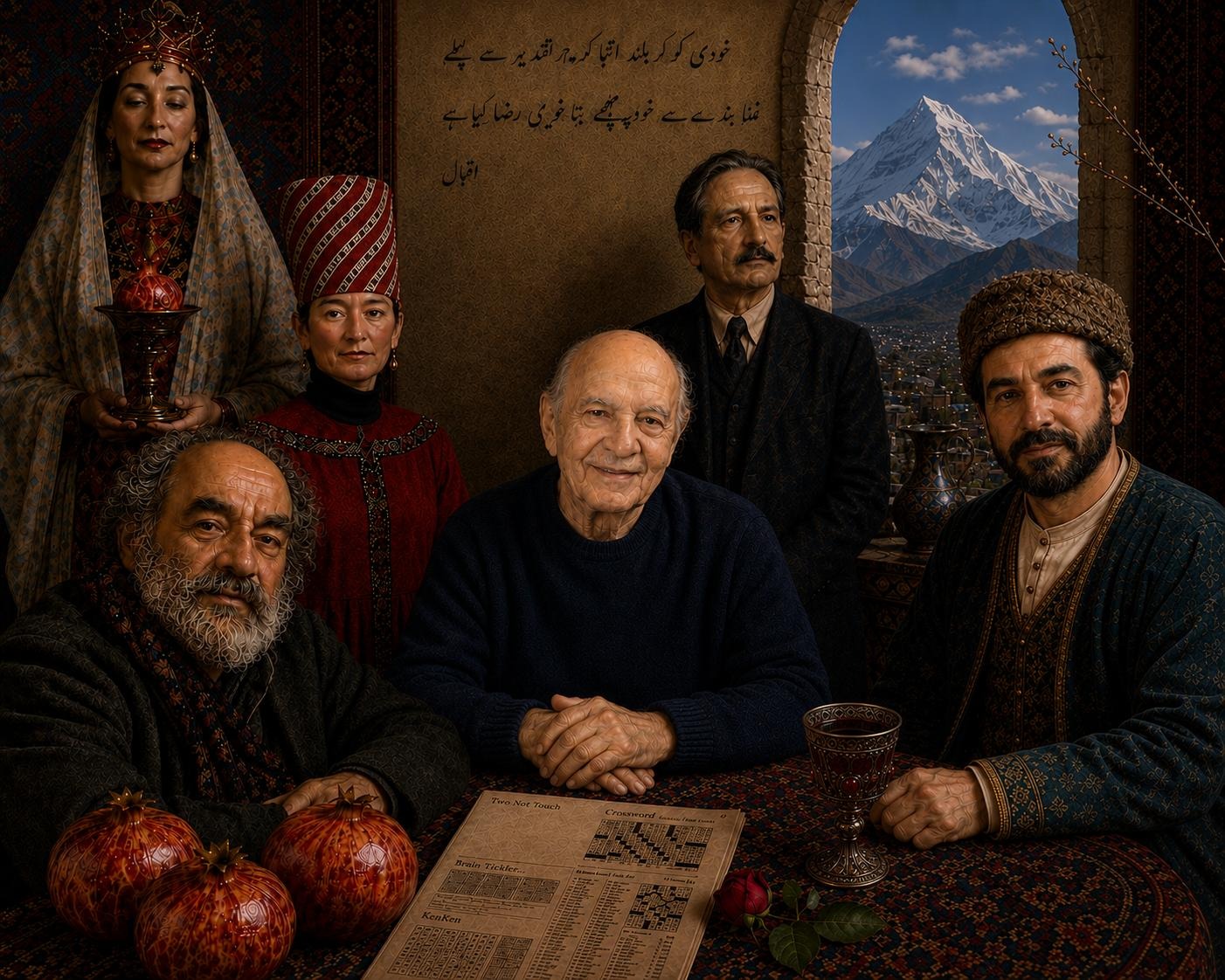
The phone lit up – it was an email from my friend Joanna inviting me to watch Parajanov’s The Color of Pomegranates. I read her note and then resolutely put my phone away – Steve was still on my mind. At the recommendation of my film-buff mesho Partha, I had in fact already seen the film with my book-cine club SANSAR (a fun acronym for our group). We had all sat through the movie open-mouthed, having never seen anything like it. For me, it had been an amazing and intense, virginal kind of experience, and I was thus pleased that, ahead of the viewing, I had decided not to read up on a movie or a director I knew nothing about. After, we marveled at how a movie of tableaux vivants, staccato scenes of stylized frozen poses, almost no dialogue, an exquisite drama of color in each frame – “like the pages of an illuminated manuscript, an art museum that comes to you” (Joanna’s words) – could so effectively and beautifully tell a story, that of the 17th century Armenian troubadour Sayat-Nova, capturing forever the feel of a time and a place he had happened to inhabit. And later, I had wept when I learned how Stalinist and Brezhnev-era Russia had treated its unusually brilliant and usually dissenting director-auteur, repeatedly incarcerating him on various pretexts, including suspicions about his homosexuality.
A pinched bud ― and a message is unfurled. A wine-cup ― and
I see the mirrored world.
My two hours were up, and I went to hang out with my English-Urdu-Punjabi-Hindi-speaking father, 102, who lives with us. Our cherished times together have him reading or reciting English and Urdu poetry to me. And this day he recited my favorite Iqbal poem, yet again. Not counting English, my primary Indian language is Hindi, and I cannot at all read the Persian-Arabic script of Urdu. With Papa translating some words, I have mostly understood the poem – spoken Hindi and Urdu have a great deal in common. I have wanted more but have been disappointed in the English translations found online or in Papa’s books.
Later, sitting up in bed and on impulse, maybe to interrupt my zombie-scrolling on Insta (yes! my phone was now back with me), I wrote to a friend in India about translating this poem, not sure that he would ever respond to my text or even read it. I knew it would all depend on his mood and circumstances.
At last, I had a translation that, with its perfect cadence and delicacy, spoke to me in much the same voice as the parts of the original I had understood.
I woke up the next morning to an email from Vikram Seth, with the subject line Ek Arzoo and his gorgeous translation in the body of the mail – just the poem gleaming at me, its meter, layout, spacing, and font carefully chosen (I knew). “Whoa!” I said to myself, followed soon after by a whispered “Wow!”
And, here it is, the pearl of this oyster:
A Wish
The gatherings of this world have left me bored.
They’ve lost all joy: my heart’s burned out, O Lord.

I flee from tumult – and I seek to reach
That silence that is longed for even by speech.

I yearn for silence – that I might abide
In a small hut upon a mountainside,

Carefree, to live my days from all apart –
The thorn of the world’s grief pulled from my heart.

In the birds’ chirps I’d hear the sarod ring,
And music in the splashing of the spring.

A pinched bud – and a message is unfurled.
A wine-cup – and I see the mirrored world.

My arm’s my pillow; the green grass my bed –
What shames the world is done alone instead.

May the bulbul get so used to my face
That her small heart should not increase its pace.

On both sides may the trees and shrubs be green
And their clean image in the river seen,

And may the mountain view so lovely be
That water forms high waves to rise and see.

May blossoming branches touch the brook with grace –
As though some beauty leaned to view her face.

May, in earth’s lap, the sleeping life be green,
So that each bush-bound runnel holds a sheen.

When the late sun hennas the evening’s bride,
May each flower’s tunic with red-gold be dyed.

When the night traveller wanders wearily,
May my cracked earthen lamp his comfort be.

May lightning flash to let his eyes descry
My hut, when clouds have darkened the whole sky.

Dawn’s koyal, the muezzin of the shrine,
May I be his companion, and he mine;

My ears to mosque or temple never drawn;
My hut’s small entrance my one sign of dawn.

When the dew comes to wash the flowers with care,
Let tears be my ablution, cries my prayer.

May my great lamentation upward rise
And rouse the starry caravan of the skies.

May every tender heart weep when I weep
And the unconscious waken from their sleep.
Allama Iqbal’s ‘Ek Arzoo’ (1906), translated from the Urdu by Vikram Seth
At last, I had a translation that, with its perfect cadence and delicacy, spoke to me in much the same voice as the parts of the original I had understood; it also evoked the same feelings and emotions. But now the poem was complete – and thus, for me, so much more.
Thank you, Vikram, for this gift!
These articles are, aspirationally, my miniatures, à la Parajanov.
Not as strictly, Vikram, but still conversationally…
I was on a high –
I didn’t need the caffeine,
Yet hard to discard
Are rituals and routine.
As I steeped a tea-ball of Madurai Masala Blend, I slipped the Arts Section out of our NYTimes and refolded it to open at page C3. But before I could start with the crossword puzzle at the bottom, the story in the top half caught my attention: Different Takes on the Current State of Things, three one-woman shows at the Bricks Festival that poke and prod at identity, culture and the justice system. Leslie uses the feminist lens of “an acquiescent good girl who wakes up and realizes that there are better, bolder ways to navigate the world.” Liza Jessie forcefully talks about “the racist injustices of the justice system.” Kathryn says, “Welcome to my mind!” as she talks of bats who “know who they are and where they are going by hearing these pinging sounds off their shared caves and each other.” And I thought to myself: I once drove cars with the license plates HIPI WNB and YONEE, I am still worrying about inequity and injustice in the world.
And perhaps our echolocation-pings to one another through IHF will help us know better who we are and where we are going.
In an amazing consilience between the two halves of C3, the theme of Monday’s puzzle turned out to be Hot, Hot, Hot! The stars were aligned, three bulbuls had lined up.
I hope to meet you here on the 18th of each month.
These articles are, aspirationally, my miniatures, à la Parajanov. Like Iqbal – looking down into his jām-e-jam – I hope to see reflections of the world in my wine-cup, and in the pinched bud I hope to read a message. Like the late-life shows of the female trimurti of the Bricks Festival, the essays will be “deeply personal and intrinsically political”. Usually!
Thank you, Allama Dr Sir Muhammad Iqbal, Papa and Vikram; Sergei Parajanov, Parthomesho and Joanna; Kathryn Grody, Leslie Ayvazian, and Liza Jessie Peterson!
“I’ll try not to sing out of key
So you do not walk out on me”
Are You Passionate About India's Future? Join Our Community to Collaborate, Advocate, and Create Positive Change.