
Image credits: The Guardian
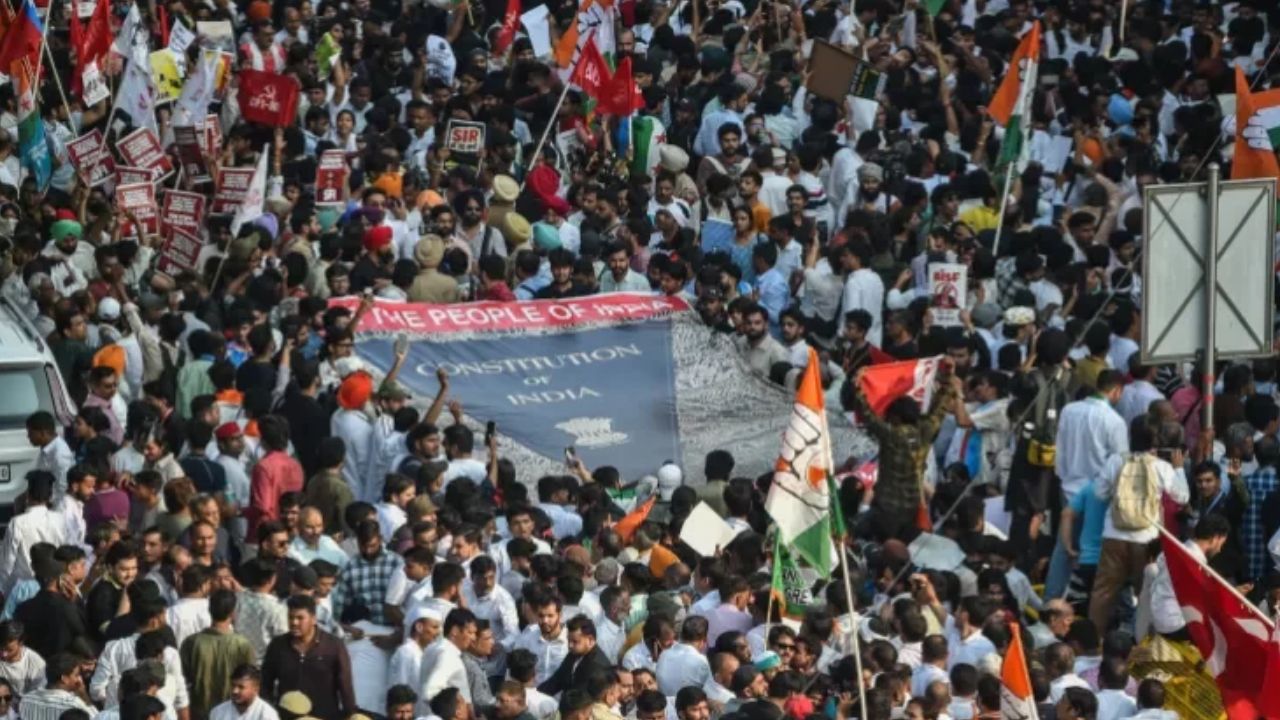
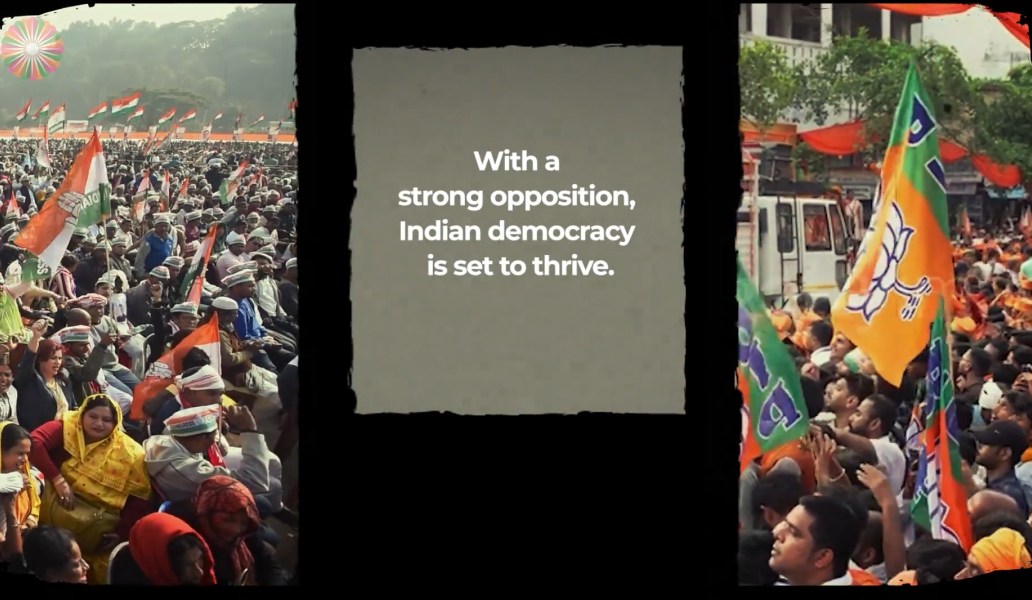
India’s political landscape presents a paradox that should disturb citizens who believe in a pluralistic republic. The BJP has captured West Bengal, the last great fortress of regional resistance, the national opposition remains a coalition of exhausted brands and leaders who inspire their partisans but bore everyone else. The Dravidian social justice bloc of Tamil Nadu, the pluralistic communitarian bloc in Kerala, the agrarian-Sikh-secular bloc of Punjab, and federalist resistance in Karnataka and Telangana are perhaps starting points, but will be too fragmented to coalesce when PM Modi seeks a fourth term in April 2029. Can India articulate a vision of itself that is more confident, more inclusive, and more emotionally resonant than the one Modi has been selling since 2014? The question is not merely electoral. It is civilizational.
Honesty First: Why Modi Keeps Winning
An honest diagnosis must resist the comforting explanation that the voters were fooled. Modi has won, repeatedly and durably, because he understands something about India’s psyche that the English-educated liberal class repeatedly refuse to take seriously: izzat ― dignity, self-respect.
The foundational factor of Modi’s rise is presidential personalization of himself as the Indian’s izzat. In 2014, the BJP transformed a parliamentary election into a referendum on a single man ― the 56-inch chest, the chai-wala origin myth, the strongman aesthetics giving voters a face onto which to project their aspirations, superseding two decades of caste-coalition grammar. By 2024, even when the BJP underperformed, Modi personally outpolled the party. Beneath this lay a structural masterstroke: the annexation of OBC identity, roughly 52% of India, into a Hindu majoritarian framework. By projecting himself as a lower-caste Ghanchi shut out by Brahmin-Bania Congress elites, Modi fused Hindu consolidation and class resentment into a single political force that an opposition rooted in upper-caste liberalism was almost constitutionally unable to answer.
Can India articulate a vision of itself that is more confident, more inclusive, and more emotionally resonant than the one Modi has been selling since 2014? The question is not merely electoral. It is civilizational.
This identity architecture was reinforced by the welfare-nationalism fusion: Ujjwala gas cylinders, Swachh Bharat toilets, PM-KISAN transfers, Jan Dhan accounts, all reaching millions of households with a Modi face, creating a direct patron-client bond that bypassed state governments entirely. The poor felt they received prosperity as Indians, not as charity cases. That demonetization devastated the informal economy and the COVID lockdown sent tens of millions of migrant workers walking home on highways with four hours’ notice were truths politically contained because the suffering fell on those with the least capacity to convert it into consequence. The playing field was further tilted: 9 million voters removed from Bengal’s rolls before 2026, the CBI and ED deployed with surgical selectivity against opposition leaders, and a media ecosystem that abandoned its adversarial function. BJP’s digital machine ― WhatsApp University, YouTube Shorts, vernacular podcasts ― reaches non-metropolitan India with a relentlessness the opposition has never matched.
The BJP’s most dangerous achievement, however, is the discursive trap. It has fused nationalism, patriotism, loyalty to the party, reverence for the PM, and national security into a single civilizational-Hindu narrative so tight that critiquing any strand triggers the full machinery of delegitimisation: questioning demonetisation is anti-national, defending a lynched Muslim is jihad sympathy, opposing Article 370’s abrogation is softness on Pakistan.
The press was conscripted into this architecture. Where earlier governments managed journalists as adversaries, the Modi dispensation delegitimized independent journalism altogether. Critical reporters became “presstitutes”, a deliberate sexualisation of accountability, or “termites”, “enemies of the state”, vectors of foreign conspiracy. When the PM of the world’s most populous democracy frames a free press as an existential threat, the consequences corrode the informational ecosystem on which democratic choice depends. The trap’s deepest effect is this: the opposition does not merely lack a better argument. The act of making any argument has been pre-emptively branded as treasonous.
Modi has won, repeatedly and durably, because he understands something about India’s psyche that the English-educated liberal class repeatedly refuse to take seriously: izzat ― dignity, self-respect.
Completing this picture is the collapse of the Congress. It built independent India, and that is its greatest asset and most debilitating curse. It remains trapped in a historical memory most Indians under 35 did not experience. While Rahul Gandhi’s Bharat Jodo Yatra did show courage, he is not a natural politician, doesn’t connect with Hindi-speaking masses, is a social democrat in a country craving a confident nationalist, and his low electoral ceiling has repeatedly been tested and confirmed. His sister Priyanka carries the Gandhi name differently, speaks far better Hindi and has the directness of Indira, but she never got a chance at the national level, unclouded by the putra-moh that has the mother-son duo running ― and inadvertently ruining ― the Congress. Having lost the young star Jyotiraditya Scindia, banished Sachin Pilot to state politics, and having sidelined Shashi Tharoor, the party’s failure to renew the face of its leadership is its most significant gift to BJP’s dominance.
Don’t Just Criticize, Present A New Vision For India
The opposition’s fatal error has been to fight the BJP on its own terrain, pitting secularism versus Hindutva, Nehru versus Modi. These arguments cannot be won because the framing is the trap. A complete reframing is needed: a new vocabulary, a new emotional register, a different idea of what India can become. Not to contest India’s civilisational greatness, but to unleash it — in every child’s classroom, in every entrepreneur’s ambition, in every farmer’s dignity, in every woman’s safety, and in every citizen’s equal standing before the law. A confident India is an inclusive India. An inclusive India is an unstoppable India.
The foundation is civilisational confidence without communal division. India’s Vedic, Buddhist, Sufi, Jain, and Sikh traditions are all sources of national pride, not competing claims. The New India does not apologise for Hindu culture but draws the line at violence: the lynching of Muslims for alleged cattle crimes, conducted with impunity since 2014 and met by the state with silence, are not a civilisational expression. They are a civilisational failure.
An economy that makes every Indian a genuine stakeholder requires legal MSP guarantees on 23 crops, not a promise but a law, not the sedition charges and the Khalistani slur that were thrown at the farmers’ protests; skill certification employers respect; land rights for women regardless of personal law; and dividends from India’s publicly built digital infrastructure distributed to every citizen.
Elections are won by strategy, organization, and timing.
Constitutional democracy must be reclaimed as national pride: Ambedkar’s Constitution is India’s own civilizational achievement, defending it is the most patriotic act available. The abrogation of Article 370 placed 8 million Kashmiris under the longest communications blackout ever imposed in a democracy. Its legacy of unfulfilled promises and deepened trauma is the cost of governance by executive decree.
Women and youth seek dignity, safety, security, and actual izzat ― a new compact, a real agency, not welfare. The solutions sought are fast-track courts, all-women police stations, property rights across all personal laws, and a genuine answer to graduate unemployment above 40%, and a real answer to over 30% underemployment.
On foreign policy, the opposition must correct, not concede to Modi’s narrative of “achievements” by working towards defining real (not reel) leadership and respect for India in global decision-making, real multipolarity, climate leadership that actually protects India’s development rights, and a coherent South Asia policy that treats neighbours as partners without compromising national security concerns.
A New Face, A Ground Game, An Early Start
A completely new and inspiring vision is necessary but not sufficient. Elections are won by strategy, organization, and timing. The window is three years. The single most important decision is the face. Rahul Gandhi’s ceiling is tested and confirmed; Priyanka carries both Indira-lookalike strengths and Vadra corruption baggage even though she hasn’t ever been fully tried; Mamata is a spent national force; Kejriwal is legally and perception-wise somewhat compromised. The ideal: an OBC or Dalit Chief Minister, Hindi-fluent, confident on national security, with a real governance record, or a total technocrat. Bhupesh Bhagel or Revanth Reddy, Siddaramaiah or Yadavs or Soren, or even a Naveen Patnaik, or most intriguingly, a completely new face from civil society or technocracy like Raghuram Rajan, someone unclouded by existing party identity.
The decision must be made by June 2027, leaving 22 months of serious national campaigning. The face must carry a narrative, not a list of grievances, with the emotional power to match the BJP’s story of civilizational restoration. It must be built in Hindi and regional languages, starting now, through leaders whose lives embody the argument. It must travel through a Hindi-first digital operation on WhatsApp University, YouTube Shorts, vernacular podcasts, professionally run and not outsourced to volunteers, because they offer more ROI than a rally in a state capital.
Power that cannot be questioned does not become wise. It becomes dangerous, then cruel, then simply embarrassing.
The coalition behind the name must assemble by January 2027 with a governance architecture, with shadow portfolios assigned, a contract/compact with the public of what the next new dispensation will achieve in the first 100 days, and at what cost, to be published as a detailed manifesto and projected by joint rallies that demonstrate a functioning team.
India’s voters know the difference between a clear, accountable, achievable manifesto that is a real contract with the people, a compact that doesn’t just signal aspiration, but accountable reckoning with seriousness and consequences. And resources must concentrate on about 180 swing constituencies won by margins under 5%. Full-time organizers by April 2027, a resource flood in the final six months: winning 130 of those 180 seats plus existing strongholds assures 272 seats, a working majority. The BJP’s dependence on TDP and JD(U), both with secular voter bases, is a structural vulnerability; a private diplomatic track from 2027 could be decisive if results are close.
Breaking the Spell
The Bengal poll result is a message: Indian voters want competence, confidence, pride, and delivery ― all four. Modi, India’s best salesman who is mistakenly seen as a visionary, has infused false confidence, false pride, and paltry delivery, though the pomp is spectacular. The opposition must offer all four in real terms, more credibly and more inclusively. But first it must break the discursive trap, reclaiming the language of nationalism and civilizational pride for the whole of India, insisting without apology that a nation diminishes itself when it silences its press, criminalizes its dissenters, and lets its minorities live in fear.
There is a word for the phenomenon that has captured Indian political imagination more completely than any BJP policy: TINA ― There Is No Alternative. It is the oldest trick in the authoritarian playbook, older than Modi, older than BJP, deployed with equal confidence by Stalin, by Putin, by the architects of North Korea’s dynastic theocracy. The cruelty of TINA is not that it is believed by fools. It is believed by intelligent people, and India has no shortage of those. A civilization that produced Aryabhata and Ramanujan and Bose, who gave the world the number zero, that runs the most complex democracy in history with 22 official languages spoken by 1.5 billion people, has somehow concluded that only one man is fit to lead it, again and again. It concedes that 1.5 billion Indians, engineers running Silicon Valley, doctors staffing the NHS and USA hospitals, writers winning Booker Prizes, cannot produce a single credible alternative to someone who will, like Trump, be a 78 if he assumes power again in 2029.
That is not a political reality. That is a manufactured hallucination, aided by a masterful PR-wash of Modi’s visa-denied, pogrom-tainted image from when he was chief minister of Gujarat to a vishwaguru whom only his WhatsApp followers believe and the world laughs at. The BJP’s greatest achievement is not the Ram Mandir or the G20 presidency or three consecutive electoral victories. It is the installation of TINA as a fact. There has never been a benevolent dictator. The phrase is an oxymoron dressed in a kurta. Power that cannot be questioned does not become wise. It becomes dangerous, then cruel, then simply embarrassing. India deserves better than TINA. More to the point: India already has better. It simply hasn’t been allowed to discover it yet.
India’s civilizational core is not BJP-like. It produced the Buddha and Ambedkar, Tagore and Abdul Kalam. In 1977, it threw out Indira Gandhi’s Emergency in the world’s largest democratic uprising. In 2004, it rejected India Shining when the sheen did not reach the villages. The Indian voter is not captive. The Indian voter is watching.
The opposition will not likely get another window for a long while after 2029. The question is whether, before that window closes, it will find the courage to build something genuinely new, a vision as confident as it is inclusive, as proud of India as it is honest about its failures, as emotionally resonant as it is substantively serious. If it does, 2029 is winnable. Not easily. Not without a fight. But winnable. And the time to believe and act is not a year or two from now, but now. Now!
Are You Passionate About India's Future? Join Our Community to Collaborate, Advocate, and Create Positive Change.