
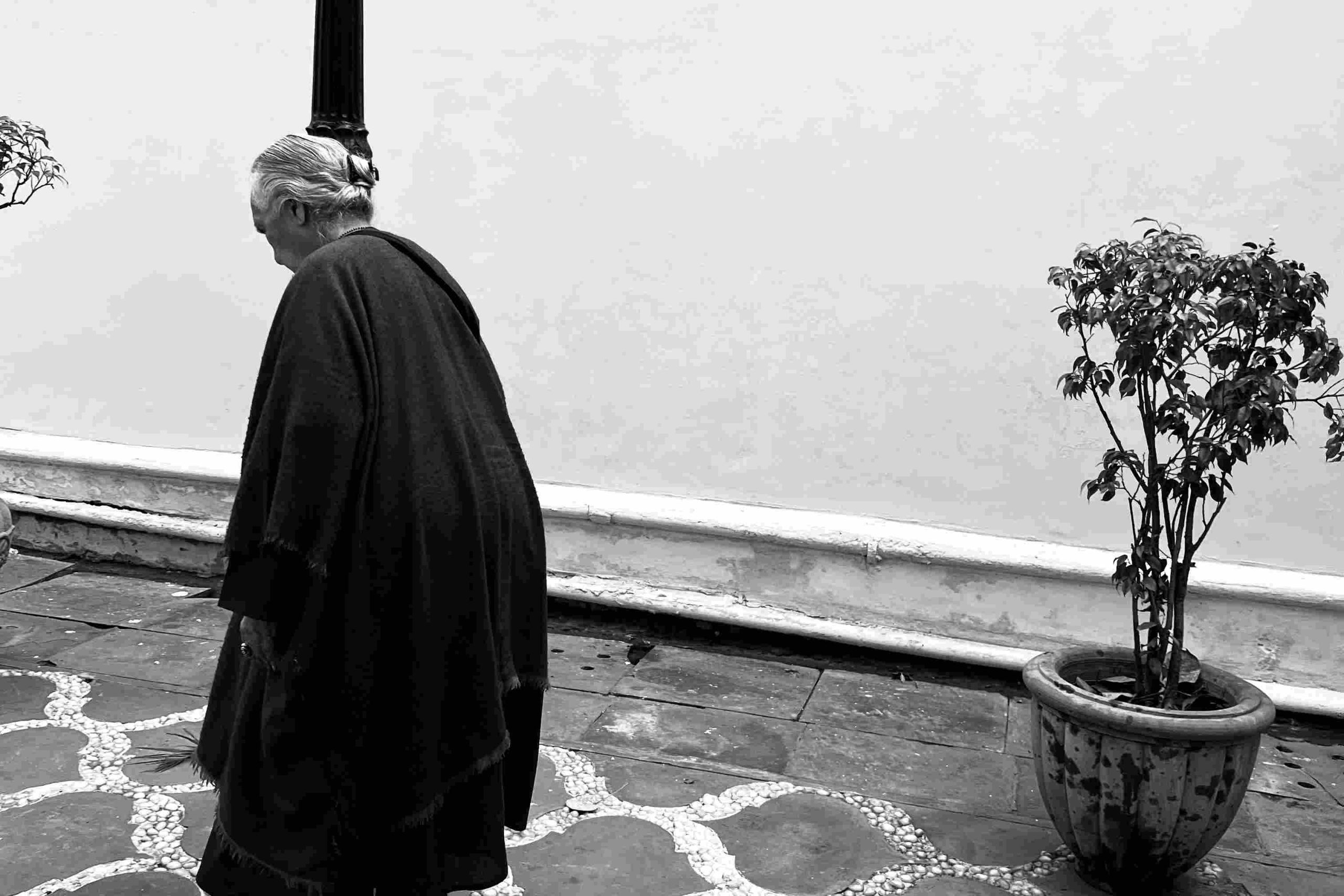

Image Credits: Naveen Kishore/Seagull Books
Romila Thapar
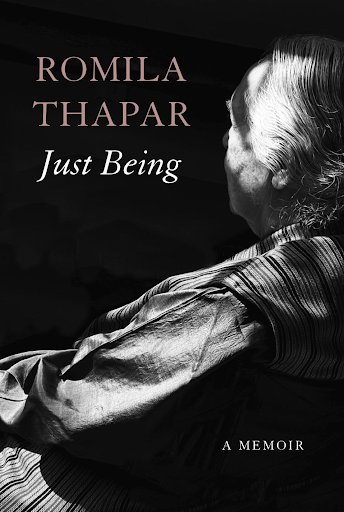
Seagull Books, Kolkata
710 pages, hardcover $25.80
US release August 5, 2026
Being a journalist for more than 40 years has raised a mental block against using the first person singular to tell a story. Bearing witness is an essential and intrinsic element of good journalism. Yet the fear of sounding immodest, conceited and indulgent prevents a reporter from using the first person singular. Even the sense of accountability and of owning what is being said did not break the mould. However, autobiography is narrative in the first person singular, and the ‘I’ in most sensitive autobiographies can never be accused of arrogance. Rather, it exposes the vulnerability of the author. The historian Romila Thapar’s autobiography, Just Being, tells us how effective the use of ‘I’ can be in capturing reality, taking responsibility, sharing ambiguous moments and fleeting situations, and a range of feelings from invincibility to helplessness.
At the beginning of the memoir, Romila Thapar says that Faiz Ahmed Faiz’s poem ‘Bol’ (Speak) urged her to write the memoir. This helps the reader to understand what is scarce today amidst the avalanche of words in the virtual world. The verse:
“Speak, for even this brief moment is ample
Prior to the dying of body and tongue.
Speak, that truth still lives
Speak, to say whatever is to be said”
In 2005, when Nepal witnessed a bizarre royal coup, a group of friends spontaneously gathered at Yelamaya Kendra in Kathmandu to recite ‘Bol’. It was a moment in which Faiz’s lines oscillated between poetry and a rallying cry. It gave people the courage to break the official censorship imposed by the Palace and to overcome the self-censorship created by fear. Faiz had become the South Asian voice against fear, hate and authoritarianism. The democratic deficit India is facing now is also twofold: the state-imposed illiberal regime, and the fear-induced self-censorship among scholars, journalists, academics and public intellectuals. It is clear that silence is not an option. But, can we overcome the stifling reality and become articulate? The full import of Just Being is all about living while existing. A close and intimate journey of erudition, this memoir opens up multiple possibilities of resistance for reclaiming what is due to us, and to have legitimate aspirations.
One cannot but marvel at Romila’s prose for its elegance and restraint
In her life, Romila has witnessed late colonial India, the freedom struggle, a newly independent India and its efforts to create effective and enduring institutions; then the phase of erasure of boundaries to create a monolith where everything is seen as an extension of the executive ― executive courts, executive legislatures, executive election commission, executive academia and executive media. Her reminiscences offer an interesting breathing space in which a reader could ask the vexatious question: ‘what if’. She recollects some of the cantonment towns of the subcontinent ― Rangoon, Peshawar, Lahore, Lucknow and Poona. How do we understand her world, in which warmth, tenderness and friendship cut across differences of language and faith? Did it owe something to the fact that Romila’s father was with the Army Medical Corps, and not one of the combatant arms? While one can never answer these questions in the affirmative without caveats, her prose is fluid and invites readers to pause and reflect. And to assume a certain level of familiarity and call Professor Romila Thapar, just Romila, without any fear of admonishment.
A few observations look like everyday occurrences, but they capture the subtle differences among people who give our households their plural texture. The phenomenon is not restricted to Romila’s family ― in every household, there is an aunt or an uncle who disdainfully uses the term ‘story books’ to describe popular works of fiction. Without labelling the class background and its attendant features, Romila hints about a section of people, including her family, who were at the top of the social pyramid but had the egalitarian imagination to flatten the pyramid. They imagined this without sloganeering. While three distinct political trajectories shaped India for the better part of the twentieth century — nationalism, the Left and the sub-regional movements ― many leaders who were from a privileged background sought a fair society which would either reduce or, if possible, eradicate discrimination. It is this notion that propelled Romila’s brother Romesh Thapar towards journalism, despite its low status then.
It is important to understand the term privilege in the context of Romila; one has to recollect the people with whom she met and interacted in what is now called the era of nation-building. She interacted with the Swiss-French architect Le Corbusier when he came to design Chandigarh; she heard Pandit Ravi Shankar explaining the nuances of Hindustani music to renowned violinist Yehudi Menuhin at a friend’s home, before a jugalbandi recital by the two stalwarts; she saw some of the major English-language plays of the Indian People’s Theatre Association (IPTA), in which her brother Romesh was an actor.
One cannot but marvel at Romila’s prose for its elegance and restraint. The story of Partition, its nightmare and trauma, comes through in a poignant manner, but not like a dirge. There is a larger metaphorical reading in the chapter, ‘Anticipation and misgivings of adolescence’, where, through youthful eyes, Romila looks at two newly independent nation-states which, in their desire to move forward, opted for selective amnesia. The cusp that would have led us to a better future took an akratic turn, to bring us into cycles of violence, hatred and loss. Romila’s recollections of the horrors of the past, and recent excesses, caution readers, but never turn pessimistic. They nurture hope. A lesser mind would have turned cynical.
Just Being is a window into Romila’s academic mind, which had made ancient Indian history her subject, and shows how she emerged as its foremost scholar
Romila’s fine application of the historical present as a narrative device gives a prescient insight not only into the people who had larger hearts, but also into the people who were comfortable with their bigotry and prejudices. The chapter ‘Becoming adult’ deals with the journey from a nationalistic outlook towards an international outlook, where other cultures, histories, struggles and aspirations were fused to create a new, syncretic political mindscape. The academic environment in London had an universalist outlook that failed to touch some. Naipaul, for instance.
“Naipaul, however, has been disappointing,” wrote Romila. Her reading of Naipaul was confirmed by another phenomenal mind, the legendary editor Diana Athill, in her memoir, Life Class. Romila occasionally met Naipaul at the home of the political cartoonist Abu Abraham. She could see the contrasting world views: the stark independent position of Abu and Naipaul’s measured take on colonialism to mask his condescending view of racial equality.
Just Being is a window into Romila’s academic mind, which had made ancient Indian history her subject, and shows how she emerged as its foremost scholar. She elaborated upon her work on Ashoka and the Mauryan period and about the tools she deployed to glean the past to come up with a credible narrative. She wrote: “I saw that I would have to comb through a large variety of sources: texts in Sanskrit, Prakrit and Pali, inscriptions in Prakrit, translations of Greek texts, as well as archaeological data. This in itself had an attraction. I argued with myself that tackling these sources would strengthen my foundation for other work in early history. There was the challenge that with so many historians having written on Ashoka, would I have anything strikingly new and worthwhile to say? I read the Pali texts Dipavamsa and Mahavamsa with Professor Godakumbara, and they were for me an introduction to viewing the past from a Buddhist perspective so different from the Brahmanical. Their non-Brahmanical view was a significant context to Ashoka’s thought.”
This profound approach of Romila and many scholars who followed in her footsteps did not extend to the historiography of peninsular India, particularly Tamil Nadu, and Tamil sources. Claims from the region were dismissed by pan-Indian scholarship in a variety of colourful ways: Tamil zealots with a frenzy for antiquity, holding blinkered positions against Sanskrit. However, recent excavations at Keeladi and Sivagalai in Tamil Nadu, representing the Sangam period and the beginning of the Iron Age in India, have rewritten the prehistory of the region. The advent of urban living and literary culture now have much earlier dates, creating a new timeline for the civilizational history of peninsular India. Why is the Archeological Survey of India sitting on the report produced by its own archaeologist Amarnath Ramakrishna? Had Romila looked at Tamil sources and interpreted them, would we have had a richer tapestry?
In 710 pages, Just Being has sowed the seeds for at least a dozen books
For long, Tamil has been a vernacular among scholars. If we recognize its classical history, like Pali and Prakrit, one may find credible answers to why modern Tamils named their principal political plank the non-Brahmin movement. The democratic nature of Romila’s history and history writing offers a dignified space for differences, and opens up the space to point out some areas that she has overlooked in her long, enriching journey of scholarship.
The chapters on the JNU years, on the media and politics, on intertwining archaeology and politics (again, I would like to link the wide exploration with Keeladi and Sivagalai under this rubric), and on the most urgent question ― is democracy fading out? ― are all subjects for full-fledged books. In 710 pages, Just Being has sowed the seeds for at least a dozen books, which would help us to understand our current status and our journey without a destination. The way forward is for us to collectively brave the shrinking democratic space and to forge a larger alliance, to create an adda where we all can speak, disagree and reimagine our futures together.
Read The Barbarians At The Gate, an extract from Romila Thapar’s memoir, Just Being.
Are You Passionate About India's Future? Join Our Community to Collaborate, Advocate, and Create Positive Change.