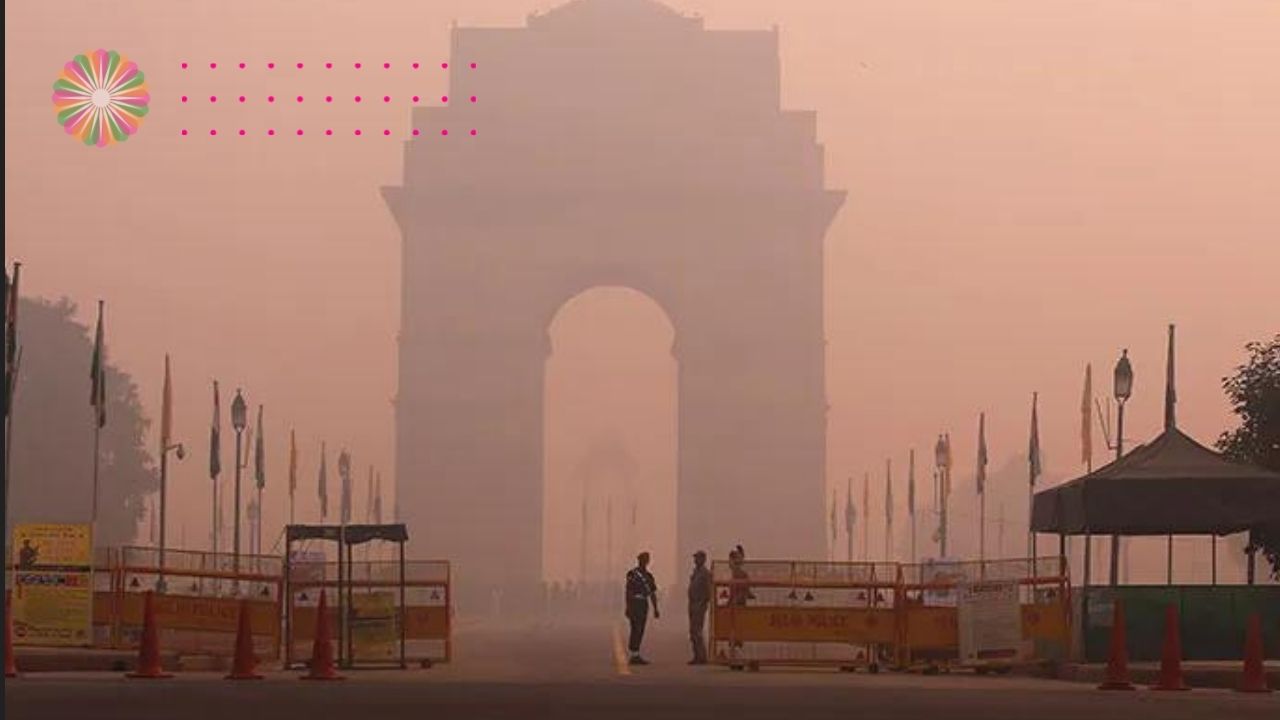
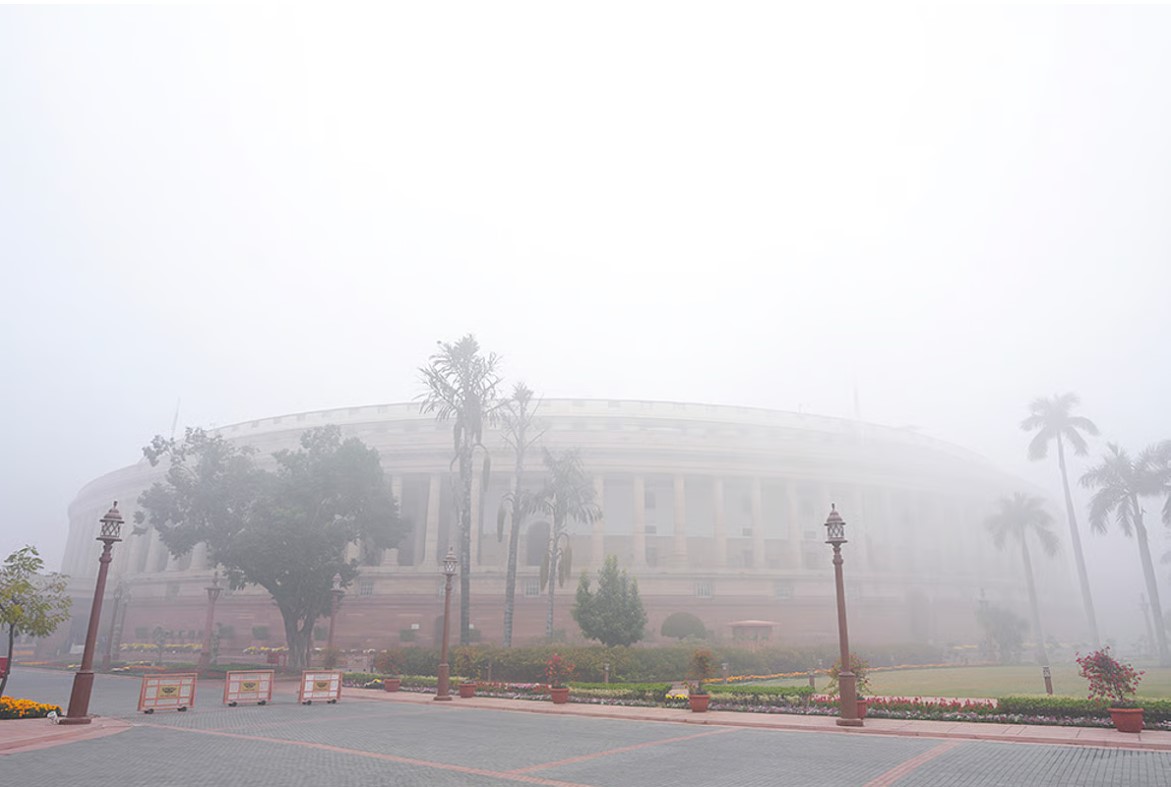

On a winter morning in Delhi, the air settles heavily over the city, thick enough to register on the skin. School buses idle at traffic lights with their windows sealed shut. A municipal worker burns a small pile of plastic behind a market because garbage collection did not arrive that day. A few kilometers away, inside a cordoned-off zone, a summit venue gleams. Security is flawless. Delegations arrive on cue. Every detail has been rehearsed. This contrast is not incidental. It captures something fundamental about contemporary India, a country that performs seemingly competently with remarkable skill on the global stage while struggling to deliver the ordinary mechanics of daily life with basic competence.
India today is applauded, most loudly by aligned Indian graduates of WhatsApp University, who were painfully visible in the recently concluded AI summit in Delhi, and who believe in a quasi-unitary state. It negotiates expansive trade agreements with the European Union and the United States. It hosts global summits with a precision that rivals that of advanced economies. It is repeatedly described as indispensable to a reordered world. The language surrounding these moments is unmistakably triumphant. India has seemingly arrived. India is courted. India matters. On the surface, none of this is false. Trade deals do bring benefits. Sometimes, in some areas, they may lower tariffs, expand markets, attract investment, and integrate India more deeply into global supply chains. Denying this would be unserious. The problem is not that these gains exist. The problem is that they are being asked to carry far more weight than they can bear.
Defenders of India’s recent trade diplomacy often respond with a question that sounds entirely reasonable. What is the harm, they ask, in having trade deals? Trade is good. Openness expands opportunity. Systems will be built alongside growth. Jobs will follow. India is too large, too complex, too democratic to sequence reform neatly. Trade, in this telling, is not a substitute for governance but a catalyst for it. This argument deserves to be taken seriously, because in other contexts it has been partly true. Trade has at times disciplined domestic reform. Global standards have sometimes forced improvements in compliance, productivity, and regulation. Political capital is finite, and governments do choose visible wins when slow institutional repair yields little immediate reward.
Trade helps a particular India, in particular sectors, on a particular timeline. But that’s where the limits lie, and that’s where perhaps the lies begin about deals as development which need to be called out.
Therefore, before rebutting this substitution of governance with the spectacle that India is being sold, it is worth stating plainly what this argument does not deny. India’s trade agreements with Europe and the United States will almost certainly produce some benefits. They will expand exports in select sectors, lower input costs for firms already positioned to scale, attract additional foreign investment, and integrate India more deeply into Western supply chains at a moment of global realignment. They may even strengthen India’s geopolitical optionality in a world increasingly structured by rivalry with China. These are real gains, and pretending otherwise would weaken the critique. The problem lies not in the existence of benefit, but in its distribution, timing, and political use. Trade helps a particular India, in particular sectors, on a particular timeline. But that’s where the limits lie, and that’s where perhaps the lies begin about deals as development which need to be called out.
And case in point here: what the Modi government and the White House are marketing as a “historic” trade deal is, at its core, a framework for an interim agreement, a provisional scaffold rather than a finished structure, with the legal text still being negotiated and key fact sheet language already amended as markets and politics react. The White House’s evolving fact sheet itself reveals shifting commitments, from tariff cuts across a broad range of U.S. industrial and food products to the removal of previously claimed digital tax concessions, underscoring that terms are being rewritten even as protests erupt back home. Just recently, on February 12, 2026, thousands of Indian farmers and trade unions called nationwide strikes, not because they misunderstand arcane tariff schedules, but because even limited reductions on commodities like soybean oil, DDGs and other agricultural imports have put downward pressure on prices and intensified anxiety in rural India, where buffers are thin and adjustment capacity is low.
Exposure arrives on schedule. Protection does not.
That anxiety echoes the logic we saw during both demonetization and the Covid response, where sudden policy shifts had immediate, painful effects on informal workers without safety nets or transport facilities, leading to so many deaths. When prices fluctuate or market access changes overnight, the effects land first and hardest on people with no social protection, no wage insurance, and no cushion, the same workers who felt the shock of losing access to their money with no preparation or compensation. In this context, the supposed gains from widened trade and deeper global integration cannot substitute for the slow, unglamorous work of governance ― building safety nets, formalizing labor, and stabilizing markets ― because talk of “historic” outcomes obscures the very real, uneven distribution of costs and the further erosion of institutional accountability that should be the precondition for trade, not its substitute.
For what the trade deals do not reliably do, especially in the absence of strong domestic systems, is generate mass formal employment, repair deep labor informality, build state capacity, create predictable regulatory enforcement, or absorb inflationary and energy shocks equitably. To acknowledge this is not to reject trade. It is to insist that trade is asked to do work that only governance can do, and that its benefits are being rhetorically substituted for harder, slower domestic repair.
Countries that succeeded with trade built systems first and opened markets afterwards. India is attempting the inverse
Trade is not neutral until proven otherwise. From the moment an agreement is signed, it redistributes bargaining power, exposure, and risk. In economies with dense institutions, those redistributions are cushioned and corrected over time. In economies with weak systems, they are absorbed unevenly and often irreversibly. India does not have the institutional depth required to treat trade liberalization as a benign background condition. By the International Labour Organization’s own estimates, roughly 88% of employment in India remains informal. Fewer than one in five workers has access to employment-linked health insurance. Pension coverage remains in the single digits. In such an economy, price shifts and competitive pressures travel quickly and land hard. Exposure arrives on schedule. Protection does not.
The historical record is instructive here. Countries that successfully used trade to transform their economies did not liberalize first and govern later. They invested early in labor absorption, skills, enforcement capacity, and institutional credibility. Trade amplified strengths that already existed. India is attempting the inverse. Tariffs fall on schedule. Competition intensifies quickly. Supply chains reorient without delay. But labor formalization has barely moved in decades, hovering below 15% of total employment. The economy absorbs shocks now. Repair remains perpetually deferred. This is not because reform is impossible, but because spectacle crowds out repair. Announcements generate applause. Systems require patience.
To understand how this imbalance is lived, one must abandon the fiction that India has a single economy or, even, that there is a single India. Broadly, there are two Indias. One India is visible. It appears in GDP projections, export curves, tariff schedules, and investor presentations. It attends Davos, Washington, Brussels, and the G20. It understands supply-chain reconfiguration and presents itself as an alternative to China. This India benefits early and visibly from trade. The other India is composed of people who rarely appear in these narratives at all. They are informal workers, daily-wage laborers, gig drivers, small farmers, street vendors, and first-generation graduates. They experience the state not as strategy but as friction. They do not appear in summit photographs, but they absorb the consequences of policy failure.
When tariffs fall, prices change. When imports increase, margins are compressed. When supply chains reorient, informal labor bears the adjustment cost. None of this appears in trade communiqués. It appears in household budgets. A rickshaw puller in Kanpur feels a fuel price increase immediately. A garment worker in Noida or Faridabad sees factory orders fluctuate while rent and food prices remain fixed. A migrant laborer in Surat or Gurugram sends half his income home and knows that one illness, or one administrative disruption, can erase years of savings. During the pandemic lockdown, tens of millions of migrant workers were displaced within weeks, not because trade failed, but because systems to absorb shock did not exist. Trade layered onto such fragility amplifies volatility rather than opportunity.
When governance is weak, trade becomes an empty drum, loud, impressive, and hollow. Spectacle is not governance. Until India repairs its systems, builds credible institutions, and measures progress in jobs rather than applause, trade will remain what it is today: impressive to watch, useful to others, and immaterial to the lives of most Indians.
The assurance that jobs will follow trade is offered with particular, almost Reaganesque, confidence. Growth creates employment, patience is required. India’s own experience complicates this optimism. The failed trickle-down economic model is sold to Indians even as it is discarded elsewhere. Over the past decade, even though India has recorded some of the fastest GDP growth rates among major economies, employment growth has lagged far behind. Manufacturing’s share of total employment has remained largely flat. Labor force participation has declined, especially for women. Growth in services has favored skills that most workers do not possess. Informality has persisted even as exports have risen. Trade agreements do not automatically generate labor-intensive employment. They generate opportunities for firms that can scale, comply, and export. In India, those firms are already near the top of the economic pyramid.
The design of India’s recent agreements reflects this imbalance. The trade pact with the European Union, widely described as historic, is primarily a tariff-liberalization agreement. It reduces duties across a broad range of goods, from automobiles and chemicals to textiles and spirits. European firms are expected to save billions annually in reduced tariffs. The agreement contains no enforceable commitments on job creation in India, no requirements for skills transfer at scale, and no mechanisms to accelerate labor formalization. Trade may grow. Jobs may not. This is not ideology. It is design.
A similar logic applies to energy and inflation. Advocates of closer alignment with the United States argue that markets will adjust, that short-term pain will be offset by long-term stability. This reasoning assumes institutional capacity that does not exist. Energy prices transmit rapidly through India’s informal economy. Fuel prices affect food, transport, construction, and household budgets. Food and fuel together account for more than half of consumption spending for the poorest 40% of households. When buffers are removed without replacement, households absorb the shock directly. Social protection does not expand automatically. Wages do not adjust in real time. Costs rise faster than incomes. This is not a moral argument about geopolitics. It is a systems argument. Energy stability is domestic infrastructure, and weak systems cannot absorb energy shocks safely.
What was presented as a principled defense of India’s poor was, in fact, a bargaining chip.
Some readers will hear in this critique an ideological objection, a hostility not merely to policy but to the governing style of the present administration in India, with its emphasis on spectacle, centralization, and symbolic dominance. That intuition is not entirely misplaced, but it is also not decisive. Values shape which questions feel urgent, but they do not determine the answers if the analysis is sound. The argument here is not that trade deals are flawed because a particular government signed them, but that any governance model which privileges visibility over institutional depth is structurally ill-equipped to translate trade into inclusive outcomes. This diagnosis would apply equally to earlier liberalizations without labor reform, to technocratic growth strategies that neglected social protection, or to any regime that confuses alignment with agency. If this assessment proves wrong, if India formalizes labor at scale, converts trade into durable employment, and builds state capacity alongside growth, the warning will simply have been outpaced by reality. The greater risk is not that India grows despite these cautions, but that it grows unevenly, politically brittle, and institutionally hollowed out.
The deepest cost of mistaking trade for governance is institutional. When spectacle is rewarded, accountability weakens. When announcements substitute for repair, systems decay quietly. India’s recent governance history reflects this pattern. Demonetization removed the vast majority of currency from circulation overnight, disproportionately harming the informal economy. The farm laws were introduced without adequate consultation and repealed after prolonged protest, leaving trust damaged and reform stalled (and now there is palpable fear that these trade deals may be backdooring some of the objections by obfuscating market entry and market conditions for the farming sector by international actors, once again without consultation). The pandemic lockdown was announced with scant hours of notice in a country where the overwhelming majority of workers lack formal employment. These were not isolated mistakes. They were expressions of a governing style that prizes decisiveness over systems. Trade deals layered onto this style do not discipline it. They legitimize it.
Let’s look at a case study of what was bargained with the US for the trade deal to be concluded — India’s energy needs partner. Indeed, the speed with which India has quietly abandoned its long-held justifications for strategic autonomy, particularly with respect to Russia, should force a pause. For over three years, the Modi government defended its refusal to condemn Russia’s brutal invasion of Ukraine using a spurious and seemingly dispensable yet consistent set of arguments. Russia, we were told, is an all-weather friend. India’s energy security required continued purchases of discounted Russian oil. Strategic autonomy demanded independence from Western pressure. India could not afford moral grandstanding when domestic stability was at stake. These arguments were not marginal. They were repeated at the highest levels of government, in Parliament, in interviews, and on international platforms. Critics were dismissed as naive or Westernized. Energy needs, we were told, were existential. India’s poor would suffer if fuel prices rose. Pragmatism, not principle, was presented as maturity.
And then, almost overnight, those arguments vanished. Under pressure from Washington and amid hard bargaining over a US-India trade deal, India agreed to halt purchases of discounted Russian oil and realign its energy imports. The same energy dependence that had been invoked to justify neutrality towards a major war was suddenly negotiable. The same strategic autonomy that was framed as sacrosanct proved to be remarkably elastic when tariffs and market access were at stake. This reversal is not merely embarrassing. It is revealing. It reveals that the earlier moral posture was not anchored in an unavoidable national constraint, but in political convenience. It reveals that what was presented as a principled defense of India’s poor was, in fact, a bargaining chip. And it reveals a deeper problem with India’s current approach to trade and diplomacy. Spectacle has replaced coherence. Rhetoric has displaced credibility. Defenders of the government will argue that circumstances change, that diplomacy requires flexibility, that trade-offs are inevitable. This is true in the abstract. But it misses the point. The problem is not that India recalibrated. The problem is that it did so without explanation, accountability, or acknowledgment of contradiction. If discounted Russian oil was essential to protect Indian households from inflation, why is it suddenly expendable? If energy security justified our morally indefensible silence on Ukraine, why does it not justify resisting American pressure now. If strategic autonomy was real, why did it collapse at the negotiating table?
India is increasingly consequential as a demographic mass and a buyer of goods, but largely inconsequential as a strategic author of events.
These questions matter because as noted above, energy is not an abstract commodity in India. Fuel prices shape food prices, transport costs, construction expenses, and household budgets. Inflation in India is immediate and regressive. In an economy where nearly 88% of employment is informal, price shocks are absorbed directly by workers with little bargaining power or protection. The government cannot claim, on Monday, that energy stability is an existential domestic priority and, on Friday, trade it away for tariff concessions without losing credibility. This pattern extends beyond Russia. India’s recent trade agreements have been celebrated as strategic breakthroughs. But in substance, they are utilitarian transactions driven by other powers’ anxieties rather than by a shared vision of India’s future. Europe’s engagement with India is driven primarily by its desire to reduce dependence on China. These are China-Negative, not India-Positive deals, and should be understood as utilitarian supply chain deals at best, not some coming home moment of values alignment strategic ally all weather moment as such. The United States sees India as a useful hedge in a polarized world. India is valuable as a market, a supplier, and a geopolitical counterweight. It is rarely treated as a strategic equal.
The larger argument, and its lack, remains — governance is not spectacle, and should not appear to be so. Governance is unglamorous. It is cumulative, technical, and often invisible. It is predictable regulation and credible enforcement. It is labor formalization that moves from single digits to scale. It is urban planning that reduces exposure rather than managing crises. It is social protection that cushions shock. It is data that is trusted because it is not curated for applause. Trade can support such governance. It cannot replace it. Countries that succeeded with trade did so because they built systems first and opened markets afterwards. India is attempting to leapfrog this sequence, with predictable results.
There is also a deeper unease that rarely makes it into the celebratory headlines, a sense that India, for all the handshakes and photo opportunities, is drifting into a kind of strategic smallness. At Davos, it is courted as a market of 1.4 billion consumers, not as a rule-setter. In trade negotiations, it is treated as a supply-chain alternative, not as an equal architect of the system. In Ukraine, it is neither mediator nor guarantor, merely an abstainer. In Gaza and West Asia it issues statements but shapes no outcomes. It remains outside the permanent decision-making core of the United Nations Security Council and absent from the rooms where ceasefires, sanctions, and reconstruction frameworks are actually drafted. The pattern is difficult to ignore. India is increasingly consequential as a demographic mass and a buyer of goods, but largely inconsequential as a strategic author of events. The country is large enough to be useful, rarely strong enough institutionally to be decisive. What is presented domestically as arrival often looks, from the outside, like utilitarian relevance. Without coherent systems at home, trade deals abroad do not translate into agency. They translate into dependence of a subtler kind, of being needed but not wanted nor heeded. In the end, what these deals and their presentation as governance fails to deliver is what most Indians want. And what most Indians want remains strikingly simple. A job that lasts. A commute that ends. Air that can be breathed. Trash that is collected. Rules that make sense. A future that does not hinge on the next announcement or crisis. An India that doesn’t discriminate or denigrate someone based on their socially ascribed markers of varna or dharma at birth. Indeed, India can sign the largest trade deals and host the grandest summits and still fail these citizens. When governance is weak, trade becomes an empty drum, loud, impressive, and hollow. Spectacle is not governance. Until India repairs its systems, builds credible institutions, and measures progress in jobs rather than applause, trade will remain what it is today: impressive to watch, useful to others, and immaterial to the lives of most Indians.
Are You Passionate About India's Future? Join Our Community to Collaborate, Advocate, and Create Positive Change.