
Late August is often a sleepy time for geopolitics, but this year at least, the last days of the month have seen an international gathering that seems to herald something significant for a fast-changing world order. In Bishkek in Kyrgyzstan, the Shanghai Cooperation Organization came together for an annual meet that looks more and more like a gathering of the key Asian actors minus the West: India, China, Russia, ASEAN and a range of central Asian countries among them.
The SCO was founded in the late 1990s under Chinese and Russian sponsorship, and India and Pakistan were jointly admitted only in 2017. But in a world where traditional US alliances are coming into question, the intra-Asian conversations facilitated by SCO have started to take on more significance.
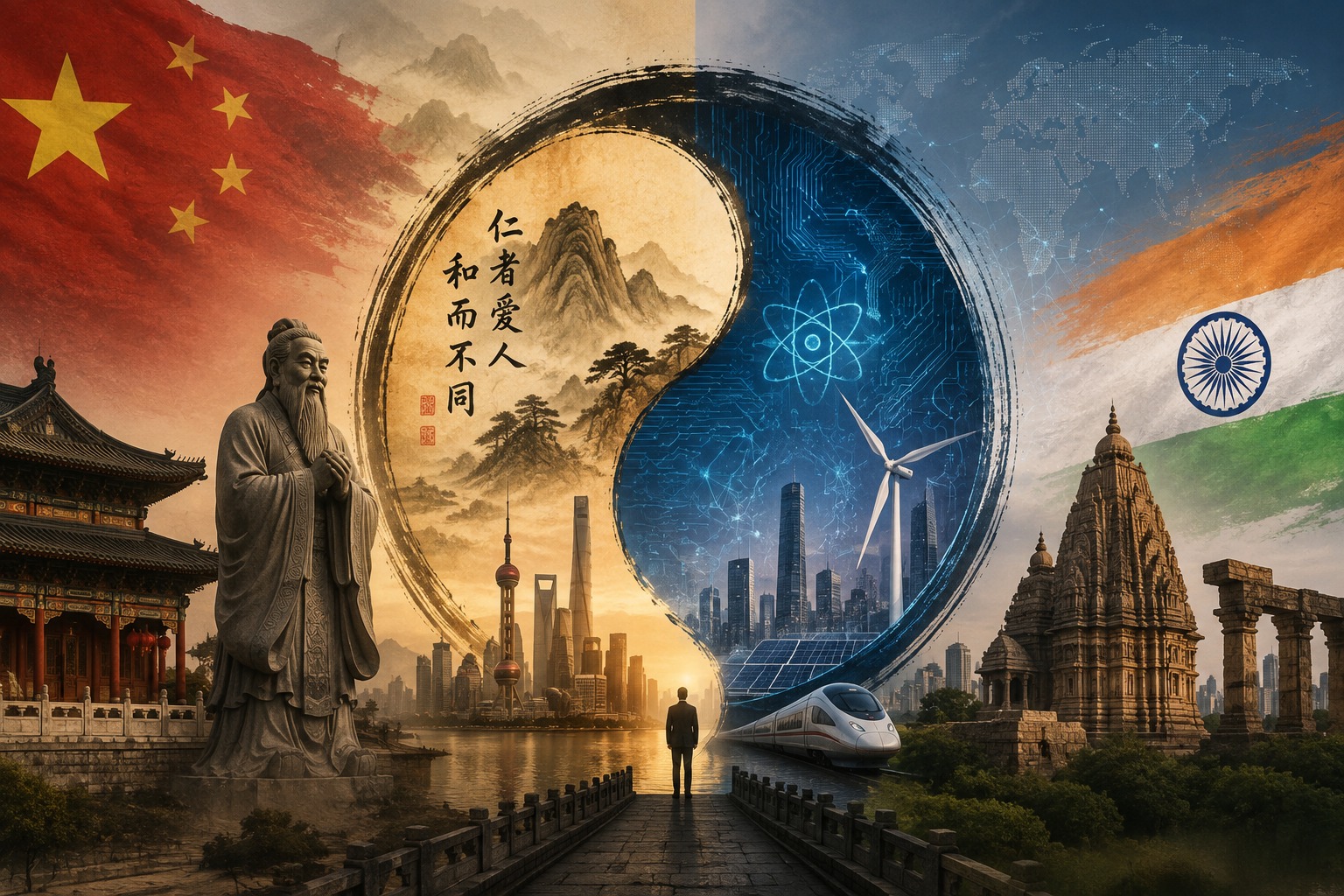
That is partly for reasons of immediate geopolitical need. But it’s also notable that one particular term, ‘civilization’, is driving many of the actors involved in shaping a new Asia. The leaders of India, China and Russia have leaned into the idea that their countries represent some sort of wider civilizational norm. In this, they are echoed by the United States, which is also drawing more heavily on the idea of Western civilization, a term often defined rather vaguely.
In the case of China, the new stress on ‘civilization’ is the product of a paradox: Beijing’s position in global politics becomes ever more prominent, while at the same time, its policymakers seem unsure as to how to define their wider purpose in the world. That is where ‘civilization’ has started to play a role.
China’s idea of ‘civilization’ encompasses not only culture but also economics and global positioning
The term ‘civilization’ has come into vogue in China’s worldview in a way that has been less widely observed in the Western world for some decades, at least since 1993, when Samuel Huntington wrote his influential essay on the ‘Clash of Civilizations’. Xi Jinping has proposed four Global Initiatives — on Governance, Development, Security, and Civilization — but the content of that civilization is not yet clear.
The ambiguity comes from the differing strands of thought that have shaped China’s development over the reform era. More than India, early twentieth century China had one significant strand of political thinking that embraced modernity by fiercely rejecting past culture rather than adapting it. Radical thinkers such as the young Mao Zedong and the modernist writer Lu Xun rejected China’s longstanding ethical and social norms, the latter writer defining Confucian thinking as no better than cannibalism. This radical rejection of the past culminated in Mao’s Cultural Revolution, which cast aside Confucius as a feudal relic, and elevated Mao’s personalized form of Marxism as the only acceptable national, and indeed global culture.
In contrast, the secular nationalist culture that shaped much of the politics and narrative of modern India has always existed alongside strands of nationalism that drew much more strongly on religious definitions of the state. Yet even that secular nationalism took pride in India’s past cultural traditions rather than rejecting them wholesale, and figures such as Gandhi were able to lean deeply into India’s traditions while creating a modern nationalist movement.
In China, the reaction to the horrors of the Cultural Revolution forced a rethink of China’s own cultural traditions, and the revival of the reputation of Confucius and other premodern thinkers. In the 1980s, Confucius was rescued from the historical cemetery and revived as a figure who embodied the best qualities of Chinese thought, including harmony and ethics — during the 2000s, China’s global program of language training institutes was even named the Confucius Institutes, a title that was more about branding than about content (classical Chinese philosophical texts were not generally taught in the Institutes).
But why should there be such a strong revival in premodern political thought in China at this moment? And does that revival parallel changes in India?
The challenge remains how to define an idea of Chinese civilization that is in the world, but can’t be accused of seeking to dominate it
First, Beijing now feels it’s imperative not to reject the past but to embrace it, so as to stress the importance of indigenous traditions. Today’s CCP wants to stress the longevity and continuity of China’s history, and Confucian values such as ‘harmony’ are part of the wider project of public education. In this, it is close to the worried elites of the late 19th century at the end of the Qing dynasty, who argued that although China could use Western thought for practical purposes, it must nonetheless stick to “Chinese essence” for key ethical issues.
Right now, one of the ways in which Chinese leaders are keen to push back against what they regard as a Western-dominated and defined world order is to stress the importance of indigenous Chinese traditions. “Outstanding” or “excellent” Chinese knowledge is presented as a gift to the wider world, and terms largely derived from the Confucian tradition are re-endowed with new significance for the modern era: for instance, terms such as “benevolence” and “harmony”.
There is, however, a recognition that the China of today exists in a world where modernity can’t simply be dismissed or wished away. One prominent television series addressed this issue in the form of dialogue: the show When Marx met Confucius (2023) featured two actors dressed as the two thinkers coming together to discuss how compatible (or not) their ideas are. The two sages exchange a range of concepts and ideas. But one topic that is not discussed is participatory democracy.
There is one area, however, where China is developing civilizational ideas at home — green energy transition. “Ecological civilization” is the phrase that expresses China’s desire to describe climate change adaptation, and the social changes surrounding that project, as more successfully achieved in an authoritarian state than in a liberal one. While the term is not (yet) widely used overseas, there will likely be further references to the concept as China becomes more dominant in the world of energy transition. Within China, there has been a rise in discussion of the links between humans and nature, a longstanding Taoist as well as Confucian theme. Again, the ability to draw on Chinese cultural tradition has dovetailed with an increasingly rapid level of scientific progress, creating a framework in which devoted attention to the long sweep of Chinese intellectual and cultural traditions is made compatible with world-class superiority in scientific achievement.
The clash or cooperation of civilizations may both be postponed as long as the actors themselves still seek to define what those civilizations actually are
Can — and would — India seek to promote this kind of combination as part of the way it presents itself to the world? The likelihood, for now, seems low, because India has no global project of the sort that China has been embracing since the start of this century. The point is that China’s idea of ‘civilization’ encompasses not only culture but also economics and global positioning, and invites comparison with rival forms, notably those of the West. India’s discourse, in contrast, seems much more oriented toward a domestic audience. Although there has been discussion about whether classical texts such as the Arthashastra might have significance in India’s self-projection in the present day, these don’t yet have the imprimatur of a governmental project that seeks major international significance.
Yet, even China’s project is still a work in progress. At the SCO meeting, most discussion was about either statements of goodwill about future cooperation, condemnation of Western sanctions on Iran (an SCO member), and only one awkward moment when Modi mildly rebuked Putin for the continuing war in Ukraine. Yet, although China continues to take a leading position in the organization, there was little overt sign of an attempt to use “civilization” to define the event.
The challenge remains how to define an idea of Chinese civilization that is in the world, but can’t be accused of seeking to dominate it. At a time when Chinese finance, trade and influence in the military and technological spheres is growing ever-faster, Beijing has not yet worked out how to project itself in a way that provides clear definition but also does not alarm its interlocutors. India, in contrast, has not yet reached a stage where its footprint is prominent enough to cause such concerns. The clash or cooperation of civilizations may both be postponed as long as the actors themselves still seek to define what those civilizations actually are.
Are You Passionate About India's Future? Join Our Community to Collaborate, Advocate, and Create Positive Change.